
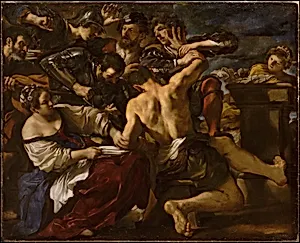
Samson Captured by the Philistines
Medium
Oil on canvas
Dimensions
75 1/4 x 93 1/4 in. (191.1 x 236.9 cm)
Classification
Paintings
Department
European Paintings
Museum
Metropolitan Museum of Art, New York, NY
Credit
Gift of Mr. and Mrs. Charles Wrightsman, 1984
Accession Number
1984.459.2
Rights
Public Domain
Tags
About this artwork
This Oil on canvas by Guercino (Giovanni Francesco Barbieri) from 1619 exemplifies historical artistic production through its materials, techniques, and aesthetic approach. Created within specific cultural and historical contexts, works like this reflect both individual artistic vision and broader patterns of workshop practice, patron expectations, and prevailing aesthetic theories. The medium of Oil on canvas required specialized knowledge developed through years of training, involving mastery ...
Art Historical Context
Guercino, born Giovanni Francesco Barbieri, painted *Samson Captured by the Philistines* in 1619 during the early years of his career in Bologna. This dramatic oil on canvas captures a pivotal moment from the biblical Book of Judges, when Samson is betrayed and overpowered by the Philistines afterilah cuts his hair. The large-scale composition, measuring over six feet wide, draws viewers into the chaos of the capture with its dynamic arrangement of figures and intense emotional energy. As a leading figure of Italian Baroque art, Guercino employed the rich tonal qualities and luminous effects possible with oil on canvas to heighten the scene’s drama. His early style often featured strong contrasts of light and shadow, expressive gestures, and vivid storytelling that brought religious narratives to life for contemporary audiences. Such works were frequently commissioned for private collections or churches, where they served both devotional and decorative purposes. Today, the painting offers modern visitors a vivid connection to seventeenth-century artistic traditions and the enduring power of biblical stories in European visual culture. Its presence in the Metropolitan Museum’s collection, thanks to a generous gift in 1984, allows us to appreciate Guercino’s technical mastery and the period’s fascination with human emotion and divine justice.
About the Artist
Guercino (Giovanni Francesco Barbieri) · 1591–1666
Guercino — the nickname meaning "squint-eyed" — was born Giovanni Francesco Barbieri in Cento, near Ferrara, in 1591. Largely self-taught in his early years, he absorbed the dramatic chiaroscuro of Ludovico Carracci's work in Bologna and the naturalistic innovations spreading from Caravaggio's circle, forging from these influences a highly personal style of extraordinary expressive power. By his e...