
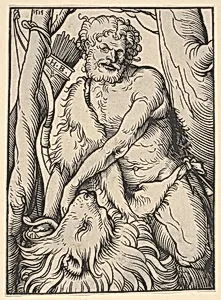
Samson Killing the Lion
1515
Medium
Woodcut
Dimensions
Sheet: 4 7/16 × 3 1/4 in. (11.2 × 8.2 cm)
Classification
Prints
Department
Drawings and Prints
Museum
Metropolitan Museum of Art, New York, NY
Credit
Harris Brisbane Dick Fund, 1937
Accession Number
37.3.12
Rights
Public Domain
Tags
Art Historical Context
Behold *Samson Killing the Lion a dynamic 1515 woodcut by Hans Burgkmair, a master of the German Renaissance from Augsburg. This intimate print (just 4 7/16 × 3 1/4 inches) captures the biblical hero Samson from the Book of Judges, tearing apart a roaring lion with his bare hands—a feat symbolizing divine strength and triumph over chaos. Burgkmair, influenced by Italian Renaissance innovations, elevated woodcuts from mere book illustrations to standalone artworks, blending intricate detail with dramatic energy. Crafted as a relief print on wood, the medium allowed for bold lines and textures that convey the lion's ferocity and Samson's muscular exertion. Burgkmair's technique shines in the interplay of light and shadow, foreshadowing chiaroscuro effects, while the small scale made it accessible for collectors and the devout public during the early Reformation era. Produced amid the explosion of printed imagery in Northern Europe, it reflects how artists like Burgkmair democratized art, spreading biblical narratives far beyond church walls. Today, housed in the Metropolitan Museum of Art's Drawings and Prints department (Harris Brisbane Dick Fund, 1937), this piece invites us to marvel at Samson's raw power and the woodcut's enduring legacy in visual storytelling. A testament to human (and heroic) might!
About the Artist
Hans Burgkmair · 1473–1531
Hans Burgkmair the Elder (1473–1531) was a German painter and printmaker who became one of the leading artists of the Renaissance in Augsburg. Born into a family of painters — his father, Thoman Burgkmair, was a respected artist — he likely received his initial training in his father's workshop. He may also have studied with Martin Schongauer in Colmar, and a probable visit to Italy around 1507 ex...