
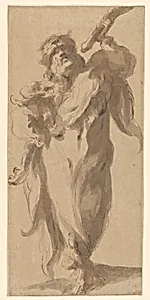
Samson (or Hercules?)
late 16th–early 17th century
Medium
Pen and brown ink, brush and brown and gray wash
Dimensions
15 5/16 x 7 1/4 in. (38.9 x 18.4 cm)
Classification
Drawings
Department
Drawings and Prints
Museum
Metropolitan Museum of Art, New York, NY
Credit
Purchase, Harris Brisbane Dick Fund and Joseph Pulitzer Bequest, 2001
Accession Number
2001.568
Rights
Public Domain
Tags
Art Historical Context
Jacques Bellange, a French draftsman and printmaker active in the court of Lorraine, created this striking figure study at the turn of the seventeenth century. Working in the elegant, elongated mannerist tradition, Bellange often depicted biblical and mythological heroes with dramatic poses and refined contours. The drawing’s uncertain title—Samson or Hercules—reflects the fluid iconography of the period, when both figures symbolized superhuman strength and could be portrayed with similar attributes. Executed in pen and brown ink with delicate washes of brown and gray, the sheet demonstrates Bellange’s masterful control of line and light. The medium allows for both precise outlines and subtle tonal modeling, giving the muscular torso a sculptural presence while maintaining the graceful, almost dance-like quality typical of his work. Such drawings were prized by collectors for their expressive energy and technical virtuosity. Acquired by the Metropolitan Museum in 2001, this rare sheet offers visitors a glimpse into the creative process of an artist whose prints and drawings influenced later generations. The ambiguity of the subject only heightens its fascination, inviting viewers to consider how Renaissance and Baroque artists blended classical and biblical ideals of heroism.
About the Artist
Jacques Bellange · 1570–1616
Jacques Bellange (c. 1575–1616) was a French artist and printmaker active in the independent Duchy of Lorraine, now part of France. Believed to have been born in the Bassigny region south of Nancy, his early life and training remain sparsely documented, with no records of specific teachers or mentors. He first appears in historical records in 1595 at La Mothe, where he took on an apprentice, sugge...