
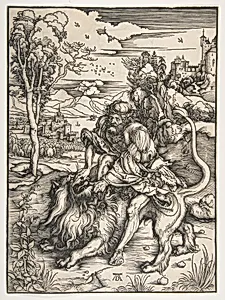
Samson Rending the Lion
ca. 1497–98
Medium
Woodcut
Dimensions
sheet: 14 3/4 x 10 13/16 in. (37.4 x 27.5 cm)
Classification
Prints
Department
Drawings and Prints
Museum
Metropolitan Museum of Art, New York, NY
Credit
Gift of Junius Spencer Morgan, 1919
Accession Number
19.73.148
Rights
Public Domain
Tags
Art Historical Context
Albrecht Dürer’s woodcut *Samson Rending the Lion*, created around 1497–98, captures a dramatic biblical moment from the Book of Judges. The young Samson is shown overpowering a lion with his bare hands, his muscular form twisting in fierce determination while the animal’s jaws gape in surprise. This early print exemplifies Dürer’s emerging mastery during the Northern Renaissance, when he was establishing himself in Nuremberg as one of Europe’s most innovative printmakers. The woodcut medium was ideally suited to Dürer’s ambitions. By carving intricate lines into wood blocks, he could produce multiple impressions that reached wide audiences, blending the precision of drawing with the bold contrasts of print. Here, the dense hatching and lively textures convey both the tension of the struggle and the lush foliage surrounding the scene, demonstrating how Dürer elevated a traditionally simple technique into a vehicle for expressive storytelling. Acquired by the Metropolitan Museum through the gift of Junius Spencer Morgan in 1919, the sheet remains a testament to Dürer’s lasting influence. His ability to infuse familiar religious narratives with dynamic energy helped shape the visual culture of the sixteenth century and continues to inspire viewers today.
About the Artist
Albrecht Dürer · 1471–1528
Albrecht Dürer (1471–1528) stands as the preeminent figure of the Northern Renaissance and arguably the most influential artist in the history of printmaking. Born in Nuremberg on May 21, 1471, and dying in the same city on April 6, 1528, Dürer revolutionized the status of the artist in Northern Europe, transforming printmaking from a commercial craft into an independent fine art and establishing ...