
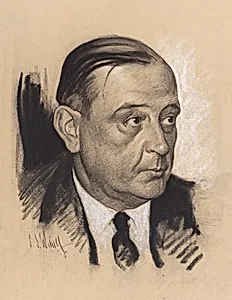
Samuel Clay Williams
Medium
Drawing
Classification
Drawing
Department
Smithsonian Collection
Museum
Smithsonian American Art Museum
Credit
National Portrait Gallery, Smithsonian Institution; gift of Time magazine
Accession Number
NPG.78.TC813
Rights
Public Domain
Tags
About this artwork
In 1978, Time magazine donated approximately eight hundred works of original cover art to the National Portrait Gallery. The museum is dedicated to telling the stories of individuals who have shaped the United States, and the Time Collection—featuring prominent international figures and events—enriches our understanding of the United States in a global context.
Art Historical Context
**Samuel Clay Williams**1935) is a portrait drawing by Samuel Johnson (1880–194), a renowned illustrator celebrated his vivid depictions of prominent on *Time* magazine covers. Created in 1935, this work captures Samuel Clay Williams, a distinguished lawyer and tobacco industry leader who served as president of R. Reynolds Tobacco Company during pivotal era for American business. Woolf's precise graphite or charcoal technique—hallmarks of his realistic style—brings out Williams's formal attire, including a neatly tied necktie, evoking the poised confidence of a corporate titan amid the Great Depression. As part of the *Time* Collection, donated by the magazine in 1978 to the National Portrait Gallery, Smithsonian Institution, this drawing joins nearly 800 original cover artworks. Housed in the Smithsonian American Art Museum, it highlights how *Time*'s global lens illuminated U.S. influencers like Williams, whose tobacco empire shaped economic and cultural landscapes. The portrait's focus on subtle details, such as implications of tobacco commerce, underscores Woolf's skill in distilling personality and era into intimate, black-and-white elegance. This piece invites visitors to reflect on the interplay of industry, leadership, and media in 20th-century America, offering a window into the lives of those who defined its trajectory. (198 words)