
Samuel Ringgold
Medium
Painting
Classification
Painting
Department
Smithsonian Collection
Museum
Smithsonian American Art Museum
Credit
National Portrait Gallery, Smithsonian Institution; gift of the William Woodville Estate
Accession Number
NPG.96.93
Rights
Public Domain
Tags
About this artwork
Estate of William Woodville VIII, Washington, D.C. [d.1995]; gift 1996 to NPG
Art Historical Context
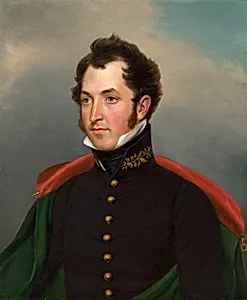
John Vanderlyn's portrait *Samuel Ringgold* (c. 1825) captures the dignified likeness of a distinguished U.S. Army officer and military engineer. Painted during the early 19th century, work exemplifies Vanderlyn's Neoclassical style, honed through his studies in Paris under Jacques-Louis David. Known for precise draftsmanship and idealized forms, Vanderlyn often portrayed American notables with a sense of classical grandeur, blending European techniques with national pride. Ringgold, depicted in a flowing cape against an exterior backdrop, embodies the era's military heroism. As a key figure in early American engineering projects and conflicts like the War of 1812, he represented the young republic's expanding ambitions. The outdoor setting and attire evoke a romanticized view of leadership, highlighting his service amid a time of national growth and frontier defense. Acquired through the Estate of William Woodville VIII and gifted to the National Portrait Gallery in 1996, this painting from the Smithsonian American Art Museum offers a window into 19th-century American identity. Its enduring presence underscores the intersection of portraiture, patriotism, and artistic legacy.