
Sandwich Glass
1936
Medium
graphite and gouache on paperboard
Dimensions
overall: 28.3 x 22.7 cm (11 1/8 x 8 15/16 in.)
Classification
Index of American Design
Department
CG-W
Museum
National Gallery of Art, Washington, D.C.
Credit
Index of American Design
Accession Number
1943.8.11237
Rights
Public Domain
Art Historical Context
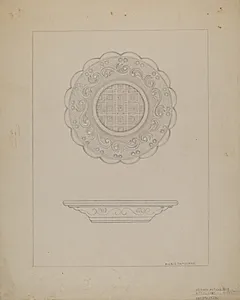
**Sandwich Glass** is a captivating rendering by artist Marie Famularo, in 1936 as part of the Index of American Design. This Federal Art Project, sponsored by the Works Progress Administration (WPA during the Great Depression, employed artists across the U.S. to document everyday objects that embodied American craftsmanship and folk art traditions. Famularo's precise depiction preserves the elegance of 19th-century Sandwich glass, produced by the Boston & Sandwich Company in Massachusetts—a hub of innovation in pressed and molded glass from the 1820s to 1888. Executed in graphite and gouache on paperboard (28.3 x 22.7 cm), the work showcases Famularo's skill in capturing fine details: the graphite outlines the intricate patterns and facets, while opaque gouache adds vibrant, lifelike color to mimic the glass's translucency and luster. These techniques were ideal for the Index's goal of creating accurate, museum-quality records, ensuring cultural treasures were archived amid economic hardship. Housed in the National Gallery of Art's collection, **Sandwich Glass** highlights America's early industrial design heritage, blending utility with artistry. It invites visitors to appreciate how everyday items like lamps or tableware reflected national pride and ingenuity, bridging colonial roots with modern aesthetics. A testament to collaborative creativity, it reminds us of art's role in safeguarding history.
About the Artist
Marie Famularo · 1901–1975
Marie Famularo (1901–1975) was an American artist whose meticulous illustrations played a vital role in preserving the visual legacy of everyday American folk art during the Great Depression era. Active primarily in the 1930s, she contributed to the Index of American Design (IAD), a groundbreaking Works Progress Administration (WPA) Federal Art Project initiative that commissioned artists to docum...