
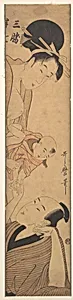
三勝と半七|Sankatsu and Hanshichi
ca. 1800
Medium
Woodblock print; ink and color on paper
Dimensions
H. 24 1/2 in. (62.2 cm); W. 5 7/8 in. (14.9 cm)
Classification
Prints
Culture & Period
Japan · Edo period (1615–1868)
Department
Asian Art
Museum
Metropolitan Museum of Art, New York, NY
Credit
Rogers Fund, 1919
Accession Number
JP1123
Rights
Public Domain
Tags
Art Historical Context
In the vibrant world of Edo-period Japan, Kitagawa Utamaro (1753–1806), a master of ukiyo—"pictures of the floating world"—ures the tragic lovers Sankatsu and Hanshichi in this striking hashira-e (pillar print). Created around 1800, the tall, narrow format (24 1/2 x 5 7/8 in.) was designed to hang on architectural pillars, immersing viewers in intimate scenes from popular kabuki theater and folklore. Here, Utamaro portrays the courtesan Sankatsu with her infant and devoted lover Hanshichi, their tender moment laced with foreboding from their ill-fated romance. This woodblock print exemplifies Utamaro's genius for bijin-ga, or "beautiful women" portraits, using delicate ink lines, gradated colors (via sophisticated bokashi shading), and subtle textures to convey emotion and elegance. Sankatsu and Hanshichi's story, inspired by a real 17th-century double suicide, gripped Edo audiences, blending pathos with the era's fascination for love, geisha culture, and the ephemeral pleasures of urban life. Housed in the Metropolitan Museum of Art's Asian Art collection (Rogers Fund, 1919), this print highlights ukiyo-e's role in democratizing art—affordable yet exquisite—shaping global perceptions of Japanese aesthetics and influencing modern masters like Toulouse-Lautrec. A poignant window into Japan's floating world!
About the Artist
Kitagawa Utamaro · 1753–1806
Kitagawa Utamaro (c. 1753-1806) was one of the most celebrated masters of ukiyo-e woodblock printing, revolutionizing the art of bijin-ga (pictures of beautiful women) during Japan's Edo period. Born Kitagawa Ichitaro, his early life remains shrouded in mystery, with conflicting accounts placing his birth in Kyoto, Osaka, Yoshiwara in Edo (modern Tokyo), or Kawagoe in Musashi Province. Under the t...