
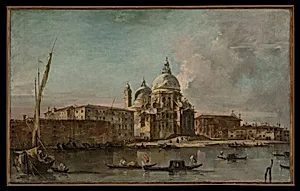
Santa Maria della Salute
mid- to late 1760s
Medium
Oil on canvas
Dimensions
21 x 33 3/4 in. (53.3 x 85.7 cm)
Classification
Paintings
Department
European Paintings
Museum
Metropolitan Museum of Art, New York, NY
Credit
Purchase, 1871
Accession Number
71.120
Rights
Public Domain
Tags
Art Historical Context
Nestled along Venice's Grand Canal, *Santa Maria della Salute* by Francesco Guardi captures one of the city's most iconic: the Baroque church of the same name, built between 1631 and 1687 to give thanks for the end of a devastating plague. Painted in the mid- to late 1760s, this oil on canvas (21 x 33 3/4 in.) exemplifies Guardi's mastery as a vedutista—a painter of topographic views—blending architectural precision with atmospheric magic. Guardi, a late 18th-century Venetian artist from the Guardi family dynasty of painters, infused his works with loose, shimmering brushwork and luminous light effects, distinguishing them from the more rigid precision of predecessors like Canaletto. Here, the church's octagonal dome and undulating facade rise dramatically against a hazy sky, with gondolas and boats dotting the canal, evoking the bustling yet timeless allure of Venetian life. Acquired by the Metropolitan Museum of Art in 1871, this piece highlights the cultural obsession with Venice during the Grand Tour era, when travelers sought souvenirs of La Serenissima's splendor. Guardi's technique, with its playful reflections on water and subtle color harmonies, foreshadows Impressionism, making it a bridge between Baroque grandeur and modern sensibilities.
About the Artist
Francesco Guardi · 1712–1793
Francesco Lazzaro Guardi (1712–1793) was born into a noble family of painters from Trentino who had settled in Venice. His father, Domenico Guardi, a minor painter trained in Vienna, died in 1716, leaving young Francesco to inherit the family workshop alongside his brothers Giovanni Antonio (Gian Antonio) and Niccolò, both artists, and sister Maria Cecilia, who married the renowned Giovanni Battis...