
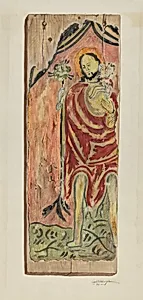
Santo (St. Joseph)
1939
Medium
watercolor, colored pencil, and graphite on paper
Dimensions
overall: 51.4 x 24.5 cm (20 1/4 x 9 5/8 in.) Original IAD Object: 25 3/4"high; 8 3/4"wide
Classification
Index of American Design
Department
CG-W
Museum
National Gallery of Art, Washington, D.C.
Credit
Index of American Design
Accession Number
1943.8.6935
Rights
Public Domain
Art Historical Context
This 1939 watercolor rendering of a santo depicting St. Joseph was created by Carl O'Bergh for the Index of American Design, a New Deal-era Federal Art Project that documented America's folk and decorative arts. Employing artists during the Great Depression, the Index produced thousands of precise illustrations to preserve visual records of traditional objects, many of which were handmade and at risk of disappearing. Santos—devotional figures of saints—are a distinctive form of religious folk sculpture, and this work captures one such example of St. Joseph with careful attention to its form and character. O'Bergh used watercolor, colored pencil, and graphite on paper to achieve remarkable fidelity to the original object's textures, colors, and details. The santo itself measured about 25 3/4 inches high, and the resulting sheet (roughly 20 by 9 5/8 inches) demonstrates the Index artists' skill in translating three-dimensional folk carvings into two-dimensional records. These mixed-media techniques allowed for both scientific accuracy and artistic sensitivity, making the drawings valuable historical documents as well as works of art in their own right. Now in the National Gallery of Art's collection, the piece offers museum visitors a glimpse into both the spiritual traditions it records and the 1930s effort to celebrate everyday American craftsmanship. It stands as a quiet testament to how art can safeguard cultural memory across generations.