
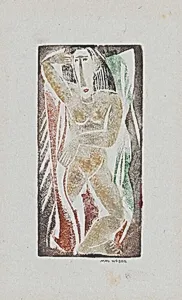
Standing Nude
1919-1920
Medium
color woodcut on wove paper
Dimensions
image: 8.1 × 3.97 cm (3 3/16 × 1 9/16 in.) sheet: 25.72 × 16.99 cm (10 1/8 × 6 11/16 in.) mount: 27.94 × 17.78 cm (11 × 7 in.)
Classification
Department
CG-W
Museum
National Gallery of Art, Washington, D.C.
Credit
Gift of Jack and Margrit Vanderryn
Accession Number
2015.114.4
Rights
Public Domain
Art Historical Context
**Standing Nude by Max Weber (1919-1920)** Max Weber's *Standing Nude*, created between 1919 and 1920, captures the modernist spirit of the early 20th century through compact color woodcut on wove paper. This intimate, with its image measuring just 8.1 × 3.97 cm, depicts a stylized female figure in a bold, abstracted pose. Weber, a Russian-born American artist pivotal in introducing European avant-garde ideas to the U.S., drew from Cubism and Expressionism during this post-World War I era, when artists sought new forms to express the human form amid rapid social change. The color woodcut technique highlights Weber's innovative approach: multiple wood blocks were meticulously carved and inked in layers to build vibrant hues and textures directly on the block, a labor-intensive method rooted in Japanese ukiyo-e but revitalized by modernists. This medium elevated prints from mere reproductions to original artworks, allowing Weber to explore angular forms and dynamic color with precision. Its small scale invites visitors to lean in, revealing the tactile grain of the woodcut. Generously gifted to the National Gallery of Art by Jack and Margrit Vanderryn, *Standing Nude* exemplifies Weber's bridge between tradition and abstraction, offering a window into the experimental printmaking that shaped American modernism. A quiet gem in the CG-W Department, it reminds us how even tiny works can embody profound artistic evolution.
About the Artist
Max Weber · 1881–1961
Max Weber (1881–1961), born in Białystok in the Russian Empire (now Poland) to Orthodox Jewish parents, immigrated to Brooklyn, New York, at age ten with his family, joining his tailor father.) There, he pursued art studies at the Pratt Institute under Arthur Wesley Dow, an innovative teacher who emphasized expression and form over traditional narrative, drawing from Japanese art and Paul Gauguin....