
Sappo
1917
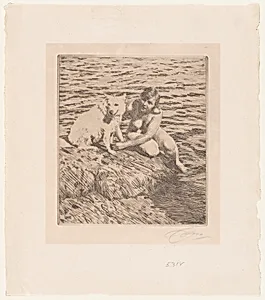
Medium
Etching; third state of three
Dimensions
Plate: 8 1/8 × 7 1/16 in. (20.6 × 18 cm) Sheet: 13 3/4 × 12 1/16 in. (35 × 30.7 cm)
Classification
Prints
Department
Drawings and Prints
Museum
Metropolitan Museum of Art, New York, NY
Credit
Gift of Edna H. Sachs, 1964
Accession Number
64.695.6
Rights
Public Domain
Tags
Art Historical Context
Anders Zorn's *Sappo* (1917) is a masterful etching that captures the sensual interplay of light and shadow on the female form, a hallmark of the Swedish artist's late-career prowess. Depicting a nude woman accompanied by her loyal dog—likely named Sappo—this third and final state of the print showcases Zorn's fascination with everyday intimacy and nature. Created during World War I, when Zorn was at the height of his international fame, the work reflects his shift toward intimate, personal subjects amid global turmoil, drawing from his lifelong study of the female nude in naturalistic settings. As an etching, *Sappo* exemplifies Zorn's virtuoso technique in drypoint and aquatint, where fine lines and subtle tonal gradations render the softness of skin, the gloss of fur, and glistening water with astonishing realism. Etchings like this were prized in early 20th-century collecting circles for their accessibility compared to paintings, allowing Zorn's luminous style—rooted in Realism with Impressionist influences—to reach wider audiences. The modest plate size (8 1/8 × 7 1/16 in.) invites close viewing, revealing the meticulous burr from drypoint that adds velvety texture. Now in the Metropolitan Museum of Art's Drawings and Prints collection, thanks to a 1964 gift, *Sappo* endures as a testament to Zorn's legacy as one of etching's greatest modern practitioners, blending eroticism, technical brilliance, and quiet domestic joy.
About the Artist
Anders Zorn · 1860–1920
Anders Zorn (1860–1920), one of Sweden's most celebrated artists, was born on February 18 in Utmeland near Mora in Dalarna, and raised on his maternal grandparents' farm in the nearby hamlet of Yvraden. Displaying prodigious talent from a young age, he attended school in Mora Strand until age twelve, followed by secondary grammar school in Enköping, where he excelled in drawing people and horses. ...