
Satan IV
1925/1927
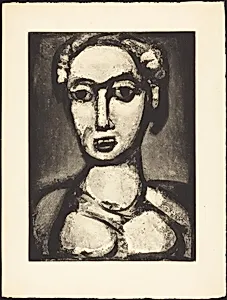
Medium
aquatint over heliogravure
Classification
Portfolio
Department
CG-W
Museum
National Gallery of Art, Washington, D.C.
Credit
Rosenwald Collection
Accession Number
1954.12.116
Rights
Public Domain
Art Historical Context
Georges Rouault’s *Satan IV* (1925/1927) belongs to a portfolio of prints that reflect the French artist’s lifelong fascination with moral and spiritual conflict. Trained first as a stained-glass apprentice, Rouault developed a signature style of heavy black contours and glowing color that gives his figures a luminous, almost iconic presence. Created in the years following World War I, the work captures the era’s widespread sense of disillusionment while continuing Rouault’s exploration of biblical and allegorical subjects. The print’s medium—aquatint over heliogravure—allowed Rouault to achieve rich tonal depths and velvety textures that heighten the dramatic tension of the image. Heliogravure provided a precise photographic base, while the subsequent aquatint layers introduced the expressive, painterly qualities for which he is celebrated. As part of the Rosenwald Collection at the National Gallery of Art, *Satan IV* exemplifies how early-twentieth-century printmaking became a powerful vehicle for both personal vision and social commentary.
About the Artist
Georges Rouault · 1871–1958
Georges-Henri Rouault was born on May 27, 1871, in a Paris cellar during the violent "Bloody Week" of the Paris Commune, when a stray shell destroyed his family's home in the working-class Belleville district. Raised by a carpenter father who worked at the Pleyel piano factory and a grandfather who collected prints by Honoré Daumier, Rembrandt, Courbet, and Manet, Rouault showed early artistic pro...