
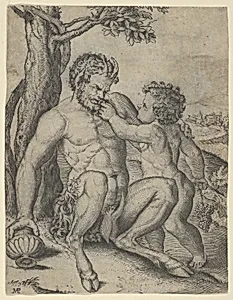
Satyr and Child
Medium
Engraving
Dimensions
Sheet: 4 13/16 × 3 3/4 in. (12.3 × 9.5 cm)
Classification
Prints
Department
Drawings and Prints
Museum
Metropolitan Museum of Art, New York, NY
Credit
Anonymous Gift, 1929
Accession Number
29.44.9
Rights
Public Domain
Tags
Art Historical Context
Behold *Satyr and Child*, a delicate engraving from around 1515–16, masterfully executed by Marcantonio Raimondi after a design by the High Renaissance genius Raphael (Raffaello Sanzio). Measuring just 4 13/16 × 3 3/4 inches, this intimate print captures a whimsical mythological scene: a playful satyr—half-man, half-beast from ancient Greek lore—interacting tenderly with a child. Housed in the Metropolitan Museum of Art's Drawings and Prints department, it exemplifies the era's fascination with classical antiquity, blending humanism with fantasy. Raimondi's engraving technique was revolutionary, using fine lines incised into a copper plate to produce multiple high-quality impressions. As Raphael's principal engraver, he democratized the master's compositions, making Renaissance ideals accessible beyond elite patrons. This collaboration bridged painting and printmaking, influencing artists across Europe during the early 16th century. The artwork's charm lies in its lively depiction of innocence meeting mischief, reflecting Raphael's graceful style—fluid forms, balanced composition, and emotional warmth. A gift to the Met in 1929, it invites visitors to ponder how myths bridged ancient worlds and the Renaissance revival, reminding us of art's enduring playfulness.
About the Artist
Marcantonio Raimondi|Raphael (Raffaello Sanzio or Santi) · 1475–1534
Marcantonio Raimondi (c. 1480–1534), born near Bologna, Italy, emerged as one of the Renaissance's premier engravers, revolutionizing printmaking through his mastery of reproductive techniques. He trained in the workshop of the goldsmith, painter, and niellist Francesco Francia, whose influence is evident in his early engravings, such as the goldsmith-like shading in *Pyramus and Thisbe* (1505), h...