
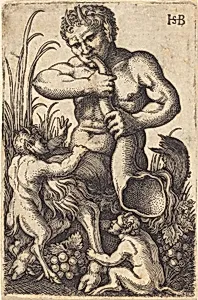
Satyr Sounding a Horn
c. 1530/1539
Medium
engraving
Classification
Department
CG-E
Museum
National Gallery of Art, Washington, D.C.
Credit
Rosenwald Collection
Accession Number
1943.3.1059
Rights
Public Domain
Art Historical Context
Behold *Satyr Sounding a Horn a captivating engraving by Sebald Beham, created around 1530–1539. Beham, a leading figure among the German "Little Masters" of the Northern Renaissance, was renowned for exquisite small-scale prints produced in Nuremberg, a hub of innovative printmaking. This work exemplifies his mastery during a time when artists revived classical mythology, blending it with the era's humanist spirit and technical precision. The image depicts a lively satyr—a mythical creature from ancient Greek lore, half-man and half-goat, symbolizing untamed revelry and nature's wild side—blasting a horn with dynamic energy. Beham's engraving technique shines here: fine, intricate lines capture the satyr's muscular form, flowing hair, and textured skin, all within a compact format ideal for collectors and wide dissemination. Engravings like this democratized art, allowing intricate designs to be reproduced and shared across Europe. Housed in the National Gallery of Art's Rosenwald Collection, this print highlights Beham's enduring influence on graphic arts, bridging pagan antiquity with Renaissance ingenuity. It's a playful yet masterful glimpse into 16th-century imagination.
About the Artist
Sebald Beham · 1500–1550
Sebald Beham (1500–1550), a pioneering German printmaker and painter born in Nuremberg, emerged as one of the most prolific artists of the Northern Renaissance. The elder brother of fellow artist Barthel Beham, he grew up in a milieu steeped in artistic tradition, though details of his early training remain sparsely documented. Recorded as a journeyman painter (Malergeselle) by 1521 and a master w...