
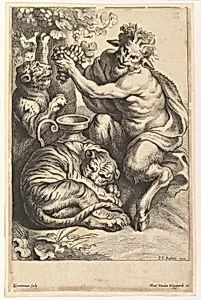
Satyr with Grapes and Two Tigers
Medium
Etching; second of two states
Dimensions
sheet: 13 7/16 x 8 11/16 in. (34.2 x 22.1 cm) mount: 13 3/4 x 9 1/16 in. (35 x 23 cm)
Classification
Prints
Department
Drawings and Prints
Museum
Metropolitan Museum of Art, New York, NY
Credit
Bequest of Phyllis Massar, 2011
Accession Number
2012.136.603
Rights
Public Domain
Tags
Art Historical Context
In the exuberant world of Flemish Baroque art, *Satyr with Grapes Two Tigers* (ca. 1614–1679) captures the wild spirit of classical mythology through the masterful design of Peter Paul Rubens, with etching by Frans van den Wijerde (1614–1679) and Vorsterman II. dynamic print, in its second state, shows a grinning satyr—half-man, half-beast—clutching grapes while flanked by prowling tigers, evokingian revelry, fertility, and untamed nature. The etching medium, with its fine lines and tonal depth, allowed for intricate details like the satyr's furred legs and the beasts' muscular forms, measuring 13 7/16 x 8 11/16 inches on the sheet. Rubens, a towering figure of the 17th-century Antwerp school, excelled in such mythological scenes, blending sensual vitality with dramatic movement to glorify the human (and animal) form. Collaborations like this with skilled printmakers were crucial: Rubens' oil sketches or drawings were translated into etchings for wider dissemination across Europe, making his grand visions accessible to collectors and enthusiasts beyond the elite. This print exemplifies how reproductive prints fueled the booming art market, preserving Rubens' Baroque exuberance in a portable format. Today, housed in the Metropolitan Museum of Art's Drawings and Prints department through the 2011 bequest of Phyllis Massar, it invites us to ponder the satyr's mischievous gaze—perhaps a nod to indulgence and the joys of the vine. A testament to Flemish ingenuity!
About the Artist
Peter Paul Rubens|Frans van den Wijngaerde, Flemish, 1614 - 1679|Lucas Vorsterman II · 1577–1640
Peter Paul Rubens (1577-1640) stands as the most influential artist of the Flemish Baroque tradition and the greatest exponent of Baroque painting's dynamism, vitality, and sensuous exuberance. Born in Siegen, Westphalia, and raised in Antwerp, Rubens received a humanist education studying Latin and classical literature before pursuing artistic training under three masters: Tobias Verhaecht, Adam ...