
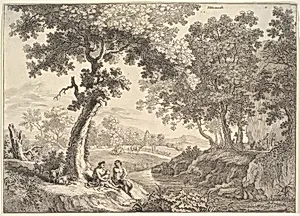
Satyrs in a Landscape
Medium
Etching
Dimensions
sheet: 7 5/8 x 10 5/8 in. (19.3 x 27 cm)
Classification
Prints
Department
Drawings and Prints
Museum
Metropolitan Museum of Art, New York, NY
Credit
Bequest of Phyllis Massar, 2011
Accession Number
2012.136.578
Rights
Public Domain
Tags
Art Historical Context
Nestled in the Metropolitan Museum of Art's and Prints department, *Satyrs in a* is a captivating etching attributed to Herman van Swanevelt or anonymous artist from his circle. Measuring 7 5/8 x 10 5/8 inches, this intimate print exemplifies the Dutch Golden Age's mastery of landscape etching, a technique where acid etches intricate lines into a metal plate reproducible, detailed imagery. Swanevelt, a 17th-century Dutch artist influenced by Italianate scenery during his Roman sojourn, often infused his works with classical mythology amid lush, pastoral settings. The scene bursts with playful satyrs—half-human, half-goat figures from Greek mythology symbolizing untamed nature and Dionysian revelry—frolicking among trees and rolling hills. This blend of whimsy and wilderness reflects Baroque interests in the pastoral idyll, evoking Arcadia's timeless harmony between myth and environment. Etching's fine lines capture the dappled light on foliage and dynamic poses with remarkable precision, making complex compositions accessible through prints. Bequeathed by Phyllis Massar in 2011, this work highlights etching's role in democratizing art, allowing collectors to own van Swanevelt-inspired visions. Visitors will delight in its lively energy, a window into 17th-century fantasies where ancient myths danced through everyday Dutch artistry.
About the Artist
Anonymous|Herman van Swanevelt
In the vast tapestry of art history, "Anonymous" stands not as a singular individual but as a collective designation for countless unidentified creators whose works have endured across millennia. These artists, spanning prehistoric cave painters to medieval illuminators and folk craftsmen, produced the foundational layers of human visual culture. Prior to the Renaissance, when individual fame emer...