
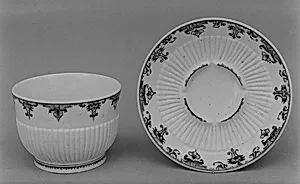
Saucer
ca. 1710–20
Medium
Soft-paste porcelain
Dimensions
Diameter: 5 1/4 in. (13.3 cm)
Classification
Ceramics-Porcelain
Culture
French, Saint-Cloud
Department
European Sculpture and Decorative Arts
Museum
Metropolitan Museum of Art, New York, NY
Credit
Gift of Alfred Duane Pell, 1902
Accession Number
02.6.68
Rights
Public Domain
Art Historical Context
This delicate saucer, produced by the Saint-Cloud in France around 1710–20, exemplifies early European porcelain innovation. Crafted soft-paste porcelain—aable mixture of white clay, ground glass, and other materials fired at lower temperatures than true hard-paste porcelain—the piece measures just 5¼ inches in diameter, perfect for serving chocolate or coffee in fashionable aristocratic households. Saint-Cloud, established around 1690 near Paris, was among the first French manufactories to rival Chinese imports, blending technical experimentation with elegant simplicity. The factory's soft-paste technique marked a pivotal moment in European ceramics, bridging the gap between costly Asian porcelain and local production during the opulent reign of Louis XIV and early Louis XV. These wares often featured molded shapes and subtle glazes, reflecting a growing taste for refined tableware amid France's "porcelain fever." Though modest in scale, this saucer highlights Saint-Cloud's role in democratizing luxury: once exclusive to royalty, such pieces soon graced bourgeois homes. Today, housed in The Metropolitan Museum of Art's Department of European Sculpture and Decorative Arts as a gift from Alfred Duane Pell in 1902, it invites us to appreciate the artistry behind everyday elegance— a testament to French ingenuity in the decorative arts.
About the Artist
Saint-Cloud factory · 1693–1766
The Saint-Cloud porcelain factory, situated on the Seine in the town of Saint-Cloud near Paris, revolutionized European ceramics as the first to manufacture soft-paste porcelain commercially, beginning in 1693. Originally established around 1664-1666 as a faience workshop, it shifted to porcelain under Pierre Chicaneau, a potter whose experiments yielded a frit-based paste with a warm yellowish or...