
Saucer
Unknown Artist
1800–1830
Medium
Earthenware, spatterware
Dimensions
Diam. 5 1/2 in. (14 cm)
Classification
Saucer
Department
The American Wing
Museum
Metropolitan Museum of Art, New York, NY
Credit
Gift of Mrs. Robert W. de Forest, 1933
Accession Number
34.100.102
Rights
Public Domain
Tags
Art Historical Context
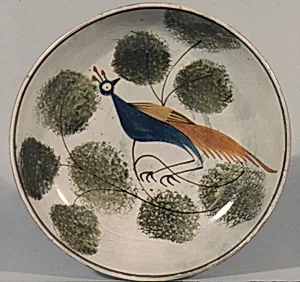
This delicate saucer, crafted from earthenware using the spatterware technique between 1800 and 1830, exemplifies early American folk pottery. Spatterware involved freely applying colorful slips—liquid clay mixtures—via sponge or brush to create vibrant, mottled patterns, often on utilitarian tableware. Measuring just ½ inches in diameter, this likely served everyday purposes in American households, blending functionality with whimsical decoration featuring peacocks, symbols of beauty and exotic allure that reflected growing tastes for ornamental domestic goods. Produced during the early years of the American Republic, the saucer captures a burgeoning national identity in ceramics, as potters drew from English traditions while embracing affordable, handcrafted styles accessible to the middle class. Its presence in The American Wing of the Metropolitan Museum of Art, gifted by Mrs. Robert W. de Forest in 1933, highlights the value placed on vernacular arts that preserved regional creativity amid industrialization. Though by an unknown artist, the saucer's lively peacock motifs and spattered hues offer a joyful glimpse into 19th-century domestic life, reminding us how everyday objects carried artistic flair and cultural pride.