
Dish
Unknown Artist
17th century
Medium
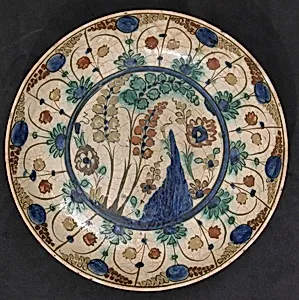
Stonepaste; underglaze painted in black, blue, and green with red and yellow slips
Dimensions
D. 13 3/8 in. (34 cm)
Classification
Ceramics
Department
Islamic Art
Museum
Metropolitan Museum of Art, New York, NY
Credit
Mr. and Mrs. Isaac D. Fletcher Collection, Bequest of Isaac D. Fletcher, 1917
Accession Number
17.120.79
Rights
Public Domain
Art Historical Context
This elegant 17th-century dish the refined ceramic artistry of the Islamic world, crafted from stonepaste—a composite material of quartz, clay, and glass frit that allowed for thin, translucent bodies mimicking porcelain. Measuring 13⅜ inches in diameter, it features undergl painting in bold black, blue, and green, accented by red and yellow applied before glazing and firing. These techniques, perfected in regions like Persia and the Ottoman Empire, produced durable, vividly colored wares that withstood daily use while dazzling the eye. In the Islamic ceramic tradition, such dishes served practical yet luxurious purposes in households, often displaying floral or geometric motifs that evoked paradise gardens—a nod to cultural and spiritual ideals. The underglaze method ensured colors remained stable through high-temperature firing, highlighting artisans' technical prowess amid a era of artistic exchange along Silk Road trade routes. Now part of the Metropolitan Museum of Art's Isaac D. Fletcher Collection (bequeathed in 1917), this anonymous masterpiece invites us to appreciate the unsung innovators whose vibrant designs bridged utility and beauty in 17th-century Islamic life.