
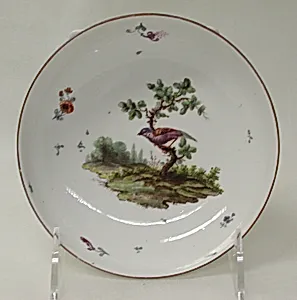
Saucer (part of a service)
Medium
Hard-paste porcelain
Dimensions
Diameter: 5 1/4 in. (13.3 cm)
Classification
Ceramics-Porcelain
Culture
German, Frankenthal
Department
European Sculpture and Decorative Arts
Museum
Metropolitan Museum of Art, New York, NY
Credit
Gift of Walter T. Rosen, in memory of his mother, Mrs. Flora Tower Rosen, 1932
Accession Number
32.71.30
Rights
Public Domain
Tags
Art Historical Context
This delicate saucer, part of a larger porcelain service crafted around 1770 at the renowned Frankenthal Porcelain Manactory in Germany, exemplifies artistry of the Karl Theodor period. Founded in 1755 under the patronage of Elector Palatine Karl Theodor the manufactory rivaled Europe's finest porcelain centers like Meissen and Sèvres. Painter Adam Bergdoll adorned this piece with vibrant motifs of birds, flowers, and trees, capturing the natural world's elegance in intricate detail. Measuring just 5¼ inches in diameter, it designed for intimate table settings, blending functionality with luxury. Made from hard-paste porcelain—a high-fired clay body prized for its strength, translucency, and pure white tone akin to Chinese exports—the saucer showcases advanced 18th-century ceramic techniques. Frankenthal artists perfected overglaze enameling, firing painted designs at lower temperatures to achieve lasting, jewel-like colors without cracking the delicate material. These naturalistic decorations reflect the era's Rococo fascination with nature, evoking pastoral idylls for aristocratic dining. Today, this saucer graces The Metropolitan Museum of Art's European Sculpture and Decorative Arts collection, a 1932 gift honoring Mrs. Flora Tower Rosen. It invites us to appreciate how porcelain bridged art and everyday life, turning a simple dish into a canvas of 18th-century refinement.