
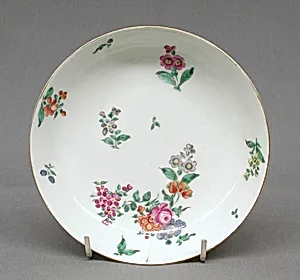
Saucer
1760–70
Medium
Soft-paste porcelain
Dimensions
Diameter: 5 1/8 in. (13 cm)
Classification
Ceramics-Porcelain
Culture
British, Worcester
Department
European Sculpture and Decorative Arts
Museum
Metropolitan Museum of Art, New York, NY
Credit
Gift of Alfred Duane Pell, 1902
Accession Number
02.6.47b
Rights
Public Domain
Tags
Art Historical Context
This delicate saucer from the Worcester, crafted between 1760 and 1770, exemplifies the golden age of British porcelain production. Made of soft-paste porcelain—a, creamy material that British makers developed to rival Chinese hard-paste imports— it measures just 5 1/8 inches in diameter, for a gentleman's tea service or a lady's dessert course. The Worcester Porcelain Works, established in 1751, quickly rose to prominence for its innovative techniques and elegant designs, blending functionality with artistry in the Rococo style popular across Europe. Adorned with floral motifs, a hallmark of Worcester's output, this saucer showcases the factory's mastery of hand-painted decoration over enamel glazes. Soft-paste allowed for finer details and vibrant colors, fired at lower temperatures to preserve delicate hues like those of blooming flowers. During the 1760s, as tea culture flourished in Britain amid growing trade with Asia, such pieces became status symbols in fashionable households, bridging everyday ritual with luxury. Today, housed in the Metropolitan Museum of Art's European Sculpture and Decorative Arts department as a 1902 gift from Alfred Duane Pell, this saucer invites us to appreciate the ingenuity of 18th-century artisans who transformed clay into coveted treasures.
About the Artist
Worcester factory · 1751–2008
The Worcester porcelain factory, established in 1751 in Worcester, England, by physician Dr. John Wall and apothecary William Davis along with 14 partners, marked the birth of one of Britain's most enduring ceramic enterprises. Investing £4,500 at Warmstry House on the River Severn, the founders drew on contacts with the Bristol porcelain manufactory to develop a novel soft-paste porcelain using s...