
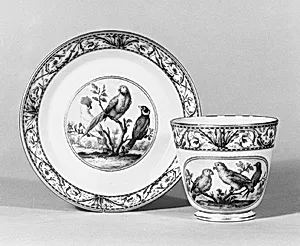
Saucer (part of a service)
ca. 1780–85
Medium
Hard-paste porcelain
Dimensions
Diameter: 5 3/8 in. (13.7 cm)
Classification
Ceramics-Porcelain
Culture
German, Meissen
Department
European Sculpture and Decorative Arts
Museum
Metropolitan Museum of Art, New York, NY
Credit
The Lesley and Emma Sheafer Collection, Bequest of Emma A. Sheafer, 1973
Accession Number
1974.356.453
Rights
Public Domain
Tags
Art Historical Context
This delicate saucer, part of a larger porcelain service produced by the renowned Meissen Manufactory during Marcolini Period (. 1780–85), exemplifies the pinnacle of 18th-century European ceramics. Meissen, based in Germany, was Europe's first producer of true hard-paste porcelain—a durable, translucent material rivaling Chinese imports that had captivated collectors for centuries. Measuring just 5⅜ inches in diameter, this piece from The Metropolitan Museum of Art's and Emma Sheafer Collection showcases the factory's mastery under director Carl Joseph von Marcolini, whose era emphasized refined neoclassical elegance over earlier baroque exuberance. Vibrantly painted with parrots amid blooming flowers, the saucer's decoration reflects Meissen's signature polychrome enameling technique, where mineral-based pigments were fired at high temperatures for lasting brilliance. Parrots, symbols of exotic luxury and the Age of Enlightenment's fascination with nature, were popular motifs, often sourced from real specimens in royal menageries. Such services were commissioned for aristocratic tables, blending functionality with artistry to elevate everyday rituals into displays of wealth and taste. As a survivor of a matching set, this saucer invites us to imagine grand 18th-century dinners, where porcelain like this bridged Eastern innovation and Western ingenuity, influencing tableware design for generations.
About the Artist
Meissen Manufactory|Marcolini Period · 1710–present
The Meissen Manufactory, established on June 6, 1710, by Augustus the Strong, Elector of Saxony and King of Poland, marked the dawn of true hard-paste porcelain production in Europe. Nestled at Albrechtsburg Castle in Meissen near Dresden, the Royal Polish and Electoral Saxon Porcelain Manufactory arose from alchemical experiments begun in 1708 by physicist Ehrenfried Walther von Tschirnhaus and p...