
Saucer (part of a service)
18th century
Medium
Hard-paste porcelain
Dimensions
Diameter: 5 3/16 in. (13.2 cm)
Classification
Ceramics-Porcelain
Culture
German, Meissen
Department
European Sculpture and Decorative Arts
Museum
Metropolitan Museum of Art, New York, NY
Credit
Gift of the Duchess Pini di San Miniato, 1982
Accession Number
1982.293.8
Rights
Public Domain
Tags
Art Historical Context
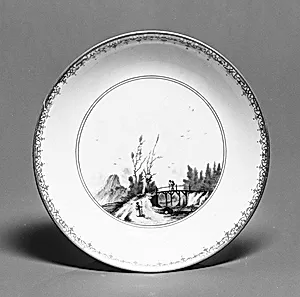
This delicate saucer, part of a larger porcelain service, hails from the renowned Meissen Manufactory Germany during the 18th century Crafted under the artistry of Christian Friedrich Herold a master painter at the factory, it exemplifies the pinnacle of European porcelain production. Measuring just 5 3/16 inches in, its hard-paste porcelain body—fired at high temperatures for exceptional durability and translucency—represents a technological breakthrough. Meissen, founded around 1710, was the first in Europe to successfully replicate Chinese hard-paste porcelain, sparking a craze among royalty and elites. Herold's handiwork shines in the saucer's painted scenes of landscapes featuring bridges, rendered in vibrant enamels overglaze. These motifs evoke romantic pastoral vistas, blending European whimsy with subtle chinoiserie influences popular at the Saxon court of Augustus the Strong. Such services were status symbols, gracing aristocratic tables and showcasing technical virtuosity in modeling, gilding, and intricate painting that withstood repeated firings. Today, this gift to the Metropolitan Museum of Art from the Duchess Pini di San Miniato in 1982 invites us to appreciate Meissen's role in elevating ceramics to high art, bridging everyday utility with opulent decoration. A testament to 18th-century innovation and elegance!
About the Artist
Meissen Manufactory|Christian Friedrich Herold · 1710–present
The Meissen Manufactory, established on June 6, 1710, by Augustus the Strong, Elector of Saxony and King of Poland, marked the dawn of true hard-paste porcelain production in Europe. Nestled at Albrechtsburg Castle in Meissen near Dresden, the Royal Polish and Electoral Saxon Porcelain Manufactory arose from alchemical experiments begun in 1708 by physicist Ehrenfried Walther von Tschirnhaus and p...