
Sausage Grinder
c. 1937
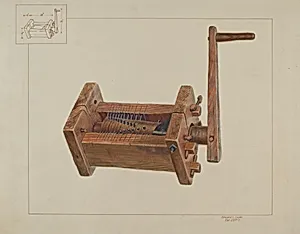
Medium
watercolor, gouache, and pen and ink on paper
Dimensions
overall: 24.4 x 31 cm (9 5/8 x 12 3/16 in.)
Classification
Index of American Design
Department
CG-W
Museum
National Gallery of Art, Washington, D.C.
Credit
Index of American Design
Accession Number
1943.8.11408
Rights
Public Domain
Art Historical Context
**Sausage Grinder** by Edward L. Loper created around 1937, captures a humble ingenious American kitchen tool through delicate watercolor, gouache, pen-and-ink on paper (24.4 x 31 cm Part of the *Index of American Design*a New Deal-era Federal Art Project (19351942)—this work how artists documented everyday objects to celebrate the nation's folk art and craftsmanship during the Great. Loper, a Philadelphia-based painter for his precise renderings, highlights the sausage grinder's sturdy metal construction and functional mechanics, evoking the practicality of 19th-century American home life. The mixed media technique is key to the *Index*'s mission: translucent watercolors suggest form and shadow, while opaque gouache adds depth to metallic surfaces, and fine pen lines deliver meticulous detail. This approach ensured accurate, almost scientific reproductions, preserving cultural artifacts for posterity amid economic hardship. Housed in the National Gallery of Art, *Sausage Grinder* underscores the *Index*'s role in valuing utilitarian design as art. It reminds us how ordinary tools embodied American ingenuity, bridging industrial innovation with domestic tradition—a timeless tribute to the makers behind our daily lives.
About the Artist
Edward L. Loper · 1916–2011
Edward Leroy Loper Sr. was born on April 7, 1916, in Wilmington, Delaware, to a poor family in the racially mixed Frogtown neighborhood, where he was raised primarily by his maternal grandmother. After graduating from Howard High School, the only secondary school available to African Americans in Delaware at the time, Loper received no formal artistic training initially but immersed himself in sel...