
Scarab: Hieroglyphs (Red Crown, nfr- and nb-Signs: Trigramme of Amun)
New Kingdom, Dynasties 18–19 (about 1550–1186 BCE)
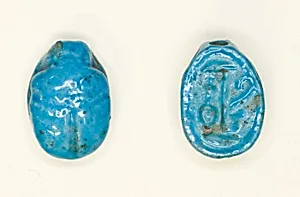
Medium
Faience
Dimensions
1.3 × 1 × 0.6 cm (1/2 × 3/8 × 1/4 in.)
Classification
scarab
Department
Arts of Africa
Museum
Art Institute of Chicago
Accession Number
134342
Rights
Public Domain
Art Historical Context
This exquisite faience scarab from ancient Egypt's New Kingdom (asties 18–19, ca. 1550–1186 BCE) is a of miniature artistry, measuring just 1.3 × 1 × 0.6 cm. Shaped like the sacred scarab beetle—symbol of the sun god Khepri and rebirth—these amulets were worn as jewelry, used as seals, or placed in tombs for protection and good fortune. Crafted from faience, a glazed ceramic composite of quartz, lime, and copper that yields a vibrant turquoise hue, it exemplifies the Egyptians' mastery of this durable, affordable medium, ideal for mass production during the empire's prosperous era. The scarab's base bears incised hieroglyphs: the Red Crown of Lower Egypt, the "nfr" sign for "beautiful" or "good," the "nb" sign for "lord," and a trigramme invoking Amun, the powerful Theban god who rose to supreme deity status under pharaohs like Amenhotep III and Ramesses II. Together, these form a potent protective formula, blending royal symbolism with divine blessing to ensure prosperity and divine favor. Housed in the Art Institute of Chicago's Arts of Africa department, this tiny talisman offers a window into New Kingdom spirituality, where everyday objects channeled eternity's magic. Visitors, pause to appreciate how such precision in micro-scale conveyed cosmic power!
About the Artist
Ancient Egyptian
Ancient Egyptian artists, a collective of highly skilled artisans spanning over three millennia from the Predynastic period (c. 6000–3150 BC) to the Roman era (30 BC–4th century AD), produced some of humanity's most enduring masterpieces. These anonymous craftsmen, often organized in state-sponsored workshops, lived in dedicated communities like Deir el-Medina near Luxor during the New Kingdom (c....