
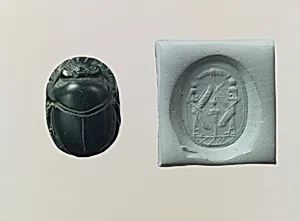
Scarab seal and modern impression: Osiris flanked by protective deities
Unknown Artist
ca. 6th–5th century BCE
Medium
Jasper, green
Dimensions
Seal Face: 1.87 x 1.39 cm Height: 1.02 cm String Hole: 0.3 cm
Classification
Stone-Stamp Seals
Period
Iron Age
Department
Ancient Near Eastern Art
Museum
Metropolitan Museum of Art, New York, NY
Credit
Bequest of W. Gedney Beatty, 1941
Accession Number
41.160.162
Rights
Public Domain
Tags
Art Historical Context
This exquisite green jasper scarab, dating to around the 6th–5th century BCE during Egypt's Late Period (Iron Age), showcases the god Osiris flanked by protective deities on its tiny engraved face (1.87 x 1.39 cm). Carved in intaglio—a technique where the design is incised below the surface for stamping into clay or wax—the seal's compact form (just 1.02 cm high) includes a perforation for stringing, allowing it to double as a wearable amulet. A modern impression reveals the crisp details of Osiris, the revered god of the afterlife and resurrection, safeguarded by flanking figures, likely goddesses like Isis and Nephthys. Scarabs like this were ubiquitous in ancient Egyptian culture, symbolizing the sun god's rebirth as embodied by the dung beetle's life cycle. Crafted from vibrant green jasper, evoking fertility and renewal, these seals served practical purposes—authenticating documents or goods—while holding profound magical power against evil. Produced in workshops during a time of Persian influence, they reflect enduring religious devotion amid political shifts. Bequeathed to the Metropolitan Museum of Art in 1941, this artifact from the Ancient Near Eastern Art department highlights the scarab's role as a personal talisman, bridging daily life and eternity for its Iron Age owner.