
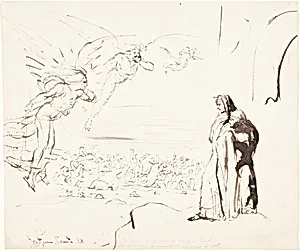
Scene from the Inferno (canto IX)
1776 to 1800
Medium
pen and black ink with gray wash
Dimensions
overall: 25.8 x 20.4 cm (10 3/16 x 8 1/16 in.)
Classification
Drawing
Department
CG-E
Museum
National Gallery of Art, Washington, D.C.
Credit
Julius S. Held Collection
Accession Number
1985.1.31
Rights
Public Domain
Art Historical Context
William Etty's *Scene from the Inferno (canto IX)*, created between 1776 and 1800, captures a dramatic moment from Dante Alighieri's epic poem *The Divine Comedy*. In Canto IX of the *Inferno*, the poet and his guide Virgil confront the menacing Furies at the walls of Dis, the infernal city, evoking themes of terror, divine wrath, and the soul's perilous journey through Hell. This pen and black ink drawing with gray wash, measuring just 25.8 x 20.4 cm, exemplifies Etty's early mastery of line and tone, likely a preparatory study blending literary inspiration with his emerging interest in history painting. The medium of pen and ink with gray wash was ideal for 18th- and early 19th-century British artists like Etty, allowing precise contours and atmospheric depth on a modest scale. Etty, who later became a Royal Academician celebrated for his muscular nudes and classical grandeur, here channels Dante's vivid medieval imagery into a Romantic-era sensibility, bridging Gothic horror with neoclassical drama. Housed in the National Gallery of Art's Julius S. Held Collection (Department CG-E), this intimate drawing offers visitors a glimpse into how Enlightenment artists reimagined eternal damnation, inviting reflection on humanity's moral struggles.
About the Artist
William Etty · 1787–1849
Painter mostly known for his life studies. He is particularly admired for the way he painted glowing and voluptuous flesh. He also did paintings of mythological and historical subjects. He trained at the Royal Academy schools and with Thomas Lawrence. British painter, York, England. Comment on works: Genre; Portraits; Mythology