
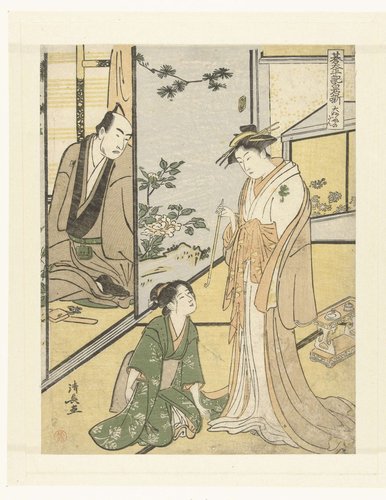
Scene in het Daifukuya huis
1783 - 1787
Medium
color woodcut
Dimensions
188; 246
Rights
Public Domain
About this artwork
collector's mark: Lugt 2971
Art Historical Context
Torii Kiyonaga's *Scene in het Daifukuya huis* (1783–1787) captures a lively moment in the famed Daifukuya teahouse of Yoshiwara, Edo's (modern Tokyo) premier pleasure district. As a leading figure in the ukiyo-e tradition—the "pictures of the floating world"—Kiyonaga specialized in bijin-ga, elegant depictions of courtesans and everyday urban life. This color woodcut, measuring a compact 246 × 188 mm, reflects vibrant social scene of late 18th-century Japan, where teahouses like Daifukuya served as hubs for entertainment, conversation, and fleeting romances amid the era's economic boom. Kiyonaga's mastery shines in his innovative use of the nishiki-e technique, layering up to 10 colors via multiple woodblocks for rich, brocade-like depth and subtle gradations. His figures exhibit graceful poise and naturalistic poses, influenced by Western perspective, setting him apart from earlier Torii school artists known for theatrical yakusha-e prints. This intimate format suggests it was designed for personal collection, affordable yet exquisite. Bearing the collector's mark Lugt 2971, this print offers a window into Edo's hedonistic culture, celebrating beauty and transience. Visitors, imagine the rustle of kimonos and scent of incense in Yoshiwara—Kiyonaga brings that world vividly alive.
About the Artist
Torii Kiyonaga · 1752–1815
Torii Kiyonaga, born Sekiguchi Shinsuke in 1752 in Uraga, Sagami Province, was the son of an Edo bookseller who owned tenements near a bustling fish market. At age 14 in 1765, he began his apprenticeship under Torii Kiyomitsu, the third-generation head of the prestigious Torii school of ukiyo-e, renowned for kabuki theater illustrations and signage. Adopted into the Torii family, Kiyonaga succeede...