
Scene in the Jewish Quarter of Constantine
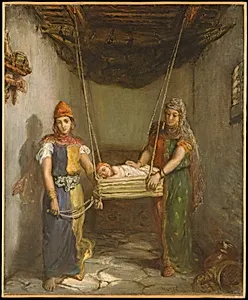
Medium
Oil on canvas
Dimensions
22 3/8 x 18 1/2 in. (56.8 x 47 cm)
Classification
Paintings
Department
European Paintings
Museum
Metropolitan Museum of Art, New York, NY
Credit
Purchase, The Annenberg Foundation Gift, 1996
Accession Number
1996.285
Rights
Public Domain
Tags
About this artwork
Théodore Chassériau's "Scene in the Jewish Quarter of Constantine" (1851) represents a pivotal work in 19th-century Orientalist painting, grounded in the artist's firsthand observations during his 1846 journey to Algeria. Unlike many European Orientalists who relied on imagination and studio fabrications, Chassériau spent several months in Constantine, producing over one thousand sketches that documented actual scenes and architectural details. From there, he wrote with ethnographic fascination:...
Art Historical Context
Théodore Chassériau's *Scene in the Jewish Quarter of Constantine* (1851), an oil on canvas, captures an intimate glimpse into North African daily life during his transformative 1846 trip to Algeria. Unlike many Orientalist painters who romanticized the exotic from afar, the Dominican-born French Romantic artist spent months in Constantine, sketching over a thousand detailed studies of real scenes and architecture. He marveled at the timeless quality of Arab and Jewish communities perched high in the mountains, blending ethnographic curiosity with artistic vision. This tender domestic moment shows a mother and grandmother tending an infant in an ingenious rocking cradle, a rare view into private Jewish homes. Chassériau was fascinated by North African Jewish women, who unlike Muslim counterparts did not veil, allowing him to portray their features and expressions with direct observation. Rich textiles, warm tonalities, and precise architectural details highlight the painting's documentary authenticity. Synthesizing his teachers Ingres's linear elegance and Delacroix's vibrant color, Chassériau's work elevated Orientalism with lived experience. It influenced later artists and fueled his career until his early death at 37 in 1856, making this a gem of 19th-century European painting at The Met.
About the Artist
Théodore Chassériau · 1819–1856
Théodore Chassériau was born on September 20, 1819, in El Limón, Samaná, in the Spanish colony of Santo Domingo — present-day Dominican Republic — to a French father and a Creole mother. The family relocated to Paris in 1820, and the young Chassériau's exceptional talent was evident almost immediately. At just eleven years old, in 1830, he was accepted into the prestigious studio of Jean-Auguste-D...