
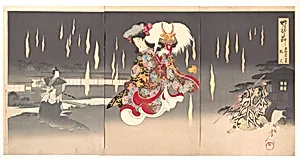
Scene of Foxfire (Kitsunebi) from the Play Honchō nijūshikō
Medium
Triptych of woodblock prints; color on paper
Dimensions
Overall (a): 14 5/8 x 9 15/16 in. (37.1 x 25.2 cm) Overall (b): 14 7/8 x 9 7/8 in. (37.8 x 25.1 cm) Overall (c): 14 5/8 x 9 15/16 in. (37.1 x 25.2 cm)
Classification
Prints
Culture & Period
Japan · Meiji period (1868–1912)
Department
Asian Art
Museum
Metropolitan Museum of Art, New York, NY
Credit
Purchase, Friends of Asian Art Gifts, 2005
Accession Number
2005.352a–c
Rights
Public Domain
Tags
Art Historical Context
This striking triptych by Yōshū Chikanobu captures a dramatic moment from the kabuki play *Honchō nijūshikō*, featuring the eerie glow of foxfire (*kitsunebi*). Created in 1898 during Japan’s Meiji period, the work reflects the era’s blend of tradition and modernity, as woodblock prints remained popular even as photography emerged. Chikanobu, a leading ukiyo-e artist of his time, specialized in theatrical scenes and historical subjects, often infusing them with vivid color and dynamic composition. The three panels together portray men and women amid flickering flames, evoking the supernatural foxes of Japanese folklore that were believed to summon illusory fires. Such imagery resonated deeply with audiences familiar with kabuki’s blend of drama, dance, and myth. As a color woodblock print on paper, the triptych format allowed Chikanobu to unfold the story across a wide, immersive scene, highlighting the technical brilliance of Meiji-era printmaking in capturing light, movement, and emotion. Housed in the Metropolitan Museum of Art’s Asian Art collection, this piece offers a window into late nineteenth-century Japanese culture, where folklore and theater continued to inspire artists navigating a rapidly changing world.
About the Artist
Yōshū (Hashimoto) Chikanobu · 1838–1912
Toyohara Chikanobu, born Hashimoto Naoyoshi in 1838 in Echigo Province (modern Niigata Prefecture), emerged as one of the last great ukiyo-e masters during Japan's Meiji era. The son of a low-ranking samurai retainer to the Sakakibara clan, he trained initially in the Kanō school of painting before turning to ukiyo-e printmaking. He studied under a disciple of Keisai Eisen, then joined the studio ...