
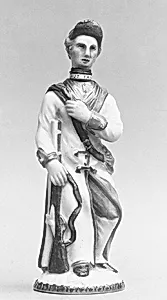
Scent bottle in the form of a hunter
ca. 1740
Medium
Porcelain
Dimensions
Height: 3 7/8 in. (9.8 cm)
Classification
Ceramics-Porcelain
Culture
German, Meissen
Department
European Sculpture and Decorative Arts
Museum
Metropolitan Museum of Art, New York, NY
Credit
Gift of J. Pierpont Morgan, 1917
Accession Number
17.190.1724
Rights
Public Domain
Tags
Art Historical Context
This delightful porcelain scent bottle, crafted the renowned Meissen Manufactory 1740, takes the whimsical form of a hunter, complete with firearms and period attire. Standing just under 4 inches tall, it exemplifies the German factory's mastery of hard-paste porcelain—a breakthrough material that rivaled Chinese imports and revolutionized European ceramics. Meissen, founded in 1710 as Europe's first true porcelain producer, became synonymous with luxury decorative arts during the Rococo, blending technical precision with playful figuration. Under the artistic direction of modeler Johann Joachim Kändler, pieces like this were hand-molded, intricately painted, and fired to achieve translucent whites and vibrant enamels. The hunter motif reflects the aristocratic fascination with hunting as both sport and status symbol, transforming a functional perfume container into a conversation piece for 18th-century collecting cabinets. Today, housed in the Metropolitan Museum of Art thanks to J. Pierpont Morgan's generosity, it invites us to appreciate how Meissen elevated everyday objects into sculptural treasures, bridging utility and opulence in the Age of Enlightenment.
About the Artist
Meissen Manufactory · 1710–present
The Meissen Manufactory, established on June 6, 1710, by Augustus the Strong, Elector of Saxony and King of Poland, marked the dawn of true hard-paste porcelain production in Europe. Nestled at Albrechtsburg Castle in Meissen near Dresden, the Royal Polish and Electoral Saxon Porcelain Manufactory arose from alchemical experiments begun in 1708 by physicist Ehrenfried Walther von Tschirnhaus and p...