
Schildering
1700 - 1750
Medium
paper
Dimensions
h 27.2cm × w 33.2cm
Classification
painting, finger painting
Museum
Rijksmuseum, Amsterdam
Rights
Public Domain
About this artwork
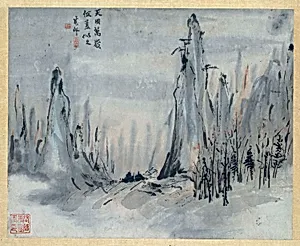
Eén van twaalf landschappen, vingerschildering met opschrift van de schilder Gao Qipei (1662 - 1731(?)). Opmerking: Zie inv. nr. AK-MAK-290.
Art Historical Context
**Schildering by Gao Qipei (c. 1700–1750)** This delicate finger painting, titled *Schildering* ( for "Painting"), is of twelve exquisite landscapes created by the innovative Qing dynasty artist Gao Qipei (1662–1731?). Rendered on paper in a compact format (272 × 33.2 cm), it Gao's pioneering technique of *zhǐ huà*—using fingers and fingernails instead of traditional brushes to apply. This intimate work likely served as an album leaf, close contemplation of misty mountains, flowing rivers, and subtle atmospheric effects typical of Chinese literati landscapes. Gao Qipei, a master of the orthodox painting tradition, elevated finger painting to an art form during the early 18th century, blending spontaneity with meticulous control. His inscription on the piece authenticates it, a common practice among scholar-artists to infuse personal poetry or philosophy. Housed alongside its series companions (see inv. nr. AK-MAK-290), this painting highlights the cultural reverence for nature in imperial China, where such works embodied harmony between artist, medium, and cosmos. Visitors will appreciate how Gao's tactile method produced bold, expressive strokes impossible with brushes, influencing later generations and bridging classical ink traditions with bold experimentation. A true gem of Sino-Dutch museum collections!
About the Artist
Gao Qipei · 1672–1732
Gao Qipei (1660-1734) was a revolutionary Chinese painter of the Qing Dynasty who is recognized as the founding father of finger painting, a technique that discarded the traditional Chinese brush in favor of using hands, fingers, palms, and nails to create paintings. Born into a Manchu military family of nobility, Gao achieved success both as an imperial official, eventually reaching the rank of v...