
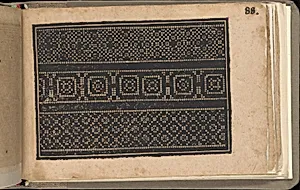
Schön newes Modelbuch (Page 88r)
Medium
Woodcut
Dimensions
Overall: 4 1/2 x 6 11/16 in. (11.5 x 17 cm)
Classification
Books|Prints|Ornament & Architecture
Department
Drawings and Prints
Museum
Metropolitan Museum of Art, New York, NY
Credit
Harris Brisbane Dick Fund, 1924
Accession Number
24.43(88r)
Rights
Public Domain
Tags
Art Historical Context
Welcome to the Metropolitan Museum of Art's Drawings and Prints collection, where we encounter *Schön newes Model (Page 88r)* by Sigismundus Latomus a woodcut from 1608. This intimate page, measuring just 4½ x 6⅝ inches, is part of a "beautiful new pattern book"—a practical guide cherished by Renaissance and early Baroque artisans across Europe. Latomus, a lesser-known but skilled designer likely working in the German-speaking regions, crafted these folios to inspire intricate ornamental motifs, blending architectural elements with flourishing scrollwork. Woodcuts like this one were revolutionary for their time, allowing affordable reproduction of complex designs via carved wooden blocks inked and pressed onto paper. Model books such as this democratized creativity, furnishing goldsmiths, embroiderers, lace-makers, and stonemasons with ready templates for everything from jewelry to facades. Page 88r exemplifies the era's fascination with grotesque ornaments—playful, symmetrical patterns echoing ancient Roman frescoes revived during the Renaissance. Its cultural footprint endures as a window into 17th-century decorative arts, highlighting how printed patterns fueled the opulent styles of the period. Purchased through the Harris Brisbane Dick Fund in 1924, this gem invites us to trace the threads of craftsmanship that adorned Europe's grand halls and humble homes alike.
About the Artist
Sigismundus Latomus · 1599–1632
Sigismundus Latomus, born in Schleusingen, Germany, around 1599, emerged as a prominent publisher and printer in Frankfurt am Main during the early seventeenth century. Little is known about his early life or formal training, as historical records focus primarily on his professional output rather than personal background. Active from 1599 until his death around 1627, Latomus specialized in the pro...