
Scrapbook with Textile Designs on Colored Papers
19th century
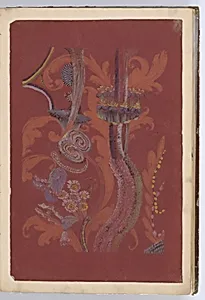
Medium
Pastel on prepared colored paper
Dimensions
20 1/2 × 14 3/16 × 1 in. (52 × 36 × 2.5 cm)
Classification
Albums|Drawings|Ornament & Architecture
Department
Drawings and Prints
Museum
Metropolitan Museum of Art, New York, NY
Credit
Gift of the Estate of Benjamin E. Marks, 1967
Accession Number
67.746.7
Rights
Public Domain
Art Historical Context
Step into the vibrant world of 19th-century French design with this enchanting *Scrapbook with Textile Designs on Colored Papers*, created by an anonymous artist. Housed in the Metropolitan Museum of Art's Department of Drawings and Prints, this album measures 20½ × 14⅜ × 1 inches and showcases a collection of intricate patterns destined for textiles, reflecting the era's booming fashion and decorative arts industries. During France's Industrial Revolution, such scrapbooks served as practical tools for designers, manufacturers, and merchants, capturing motifs that could inspire fabrics, wallpapers, or furnishings. The medium—pastel on prepared colored paper—is particularly striking. Pastels allowed for soft, luminous hues and precise detailing, while the pre-colored, textured papers provided a ready-made backdrop that enhanced vibrancy and prevented smudging, mimicking the final textile's appearance. This technique highlights the artist's skill in ornament and architecture, blending functionality with artistry in a classified album of drawings. Gifted to the Met in 1967 from the Estate of Benjamin E. Marks, this anonymous treasure offers a window into everyday creativity of the time, reminding us how ephemeral designs shaped enduring cultural aesthetics. A delightful glimpse for any visitor fascinated by the artistry behind the everyday.
About the Artist
Anonymous, French, 19th century · 1800–1900
**Anonymous, French, 19th Century (ca. 1800–1900)** The artist cataloged as Anonymous, French, 19th century embodies the enigmatic yet essential contributions of unidentified creators to France's vibrant 19th-century art world. Active roughly between 1800 and 1900, this figure—or potentially collective workshop—produced a diverse array of works amid the nation's transition from Neoclassicism thro...