
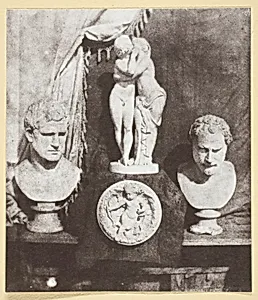
Sculptures
1839/40, printed 1985
Medium
Gelatin silver print, No. 3 from the portfolio "Bayard: XXV Calotypes, 1842-1850" (1965)
Dimensions
Image/paper/mount: 20.3 × 17.7 cm (8 × 7 in.)
Classification
photographic process
Department
Photography and Media
Museum
Art Institute of Chicago
Accession Number
23754
Rights
Public Domain
Art Historical Context
Hippolyte Bayard, a pioneering figure in the earliest days of photography, created the original image for *Sculptures* around 1839–1840. This gelatin silver print, produced in 1985 from his calotype negative, forms part of the portfolio *Bayard: XXV Calotypes, 1842–1850*. Measuring just 20.3 × 17.7 cm, the modest scale belies its importance as a window into photography’s experimental beginnings, when artists explored the medium’s ability to record form and texture with remarkable precision. The work exemplifies Bayard’s innovative use of the calotype process, an early negative-positive technique that allowed multiple prints from a single paper negative. By choosing sculptures as his subject, Bayard highlighted photography’s capacity to translate three-dimensional objects into two-dimensional images, demonstrating both technical control and an emerging artistic sensibility. Today, this later print preserves and shares one of the medium’s foundational experiments for contemporary audiences.
About the Artist
Hippolyte Bayard · 1801–1887
Hippolyte Bayard (1801–1887) was a French civil servant and artist who holds a remarkable, if bittersweet, place in the history of photography: he was one of the independent inventors of the photographic process in the late 1830s, developing his own direct positive paper print method at virtually the same moment that Louis Daguerre and William Henry Fox Talbot were arriving at their own solutions ...