
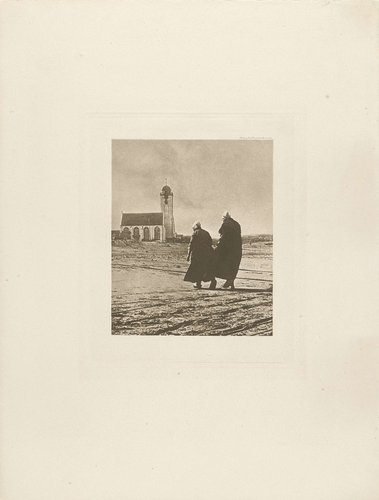
Scurrying Home
1897
Medium
photoaquatint
Dimensions
156; 486; 371; 190
Rights
Public Domain
About this artwork
Schenking van de erven van de heer C.J.J.G. Vosmaer, Leiden
Art Historical Context
**Scurrying Home** (1897) by Alfredieglitz captures the essence of urban life through the innovative medium of photoaquatint, a photomechanical process that blends photography's precision with the tonal richness of aquatint etching. Measuring just 190mm by 156mm, this intimate print evokes a sense of hurried movement—likely pedestrians rushing through city streets—reflecting the bustling energy of the fin-de-siècle era. Stieglitz, a trailblazing American photographer, created this during his early European travels and experiments, when he championed photography as a fine art equal to painting. As a leader of the Pictorialist movement, Stieglitz sought "straight photography" infused with artistic manipulation, and photoaquatint allowed him to achieve soft, painterly effects reminiscent of etchings by masters like Whistler. This technique, popular in the 1890s, democratized high-quality reproductions while elevating photography's status in galleries. *Scurrying Home* exemplifies his push against mechanical stereotypes, inviting viewers to appreciate photography's emotional depth. Generously donated by the heirs of C.J.J.G. Vosmaer from Leiden, this work graces collections today as a testament to Stieglitz's enduring influence on modern art. Imagine the patter of footsteps on wet cobblestones— a fleeting moment frozen in time.
About the Artist
Alfred Stieglitz · 1864–1946
Alfred Stieglitz (1864-1946) was a pioneering American photographer, art dealer, publisher, and advocate for the Modernist movement who was instrumental over his 50-year career in making photography an accepted art form. Born in Hoboken, New Jersey, to German Jewish immigrant parents, Stieglitz spent his formative years studying mechanical engineering in Berlin, where he discovered photography in ...