
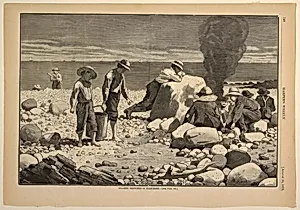
Sea-Side Sketches – A Clam-Bake
August 23, 1873
Medium
figures
Classification
figures
Department
Smithsonian Collection
Museum
Smithsonian American Art Museum
Credit
Gift of John Goldsmith Phillips, Jr.
Accession Number
1947-4-20
Rights
Public Domain
About this artwork
Research in Progress
Art Historical Context
Winslow Homer (1836–1910), one of America's foremost Realist painters, captured the vibrant energy of coastal life in *Sea-Side Sketches A Clam-Bake*, dated August 23,1873. This work, now in the Smithsonian American Art's collection (gift of John Goldsmith Phillips Jr.), belongs to Homer's series of seaside sketches, likely created during his summers in Gloucester, Massachusetts. Homer, transitioning from illustration to fine art, excelled at portraying everyday Americans at work and play, using quick, expressive drawings to study figures in their natural environments. The title evokes a classic New England "clam bake"—a communal feast where locals gathered on the beach to steam clams, corn, and seafood over hot stones covered in seaweed. Homer's focus on "figures" highlights his keen observation of human activity, rendered with loose, dynamic lines that convey motion and camaraderie amid the summer shore. These sketches, often preparatory for engravings in magazines like *Harper's Weekly*, showcase his mastery of light, gesture, and composition. Artistically, this piece reflects post-Civil War optimism and Homer's shift toward luminous marine scenes that defined his legacy. Though research continues, it offers a window into 19th-century leisure, inviting us to savor the simple joys of seaside gatherings. (198 words)