
Seal, amygdaloid
Unknown Artist
ca. 1650–1500 BCE
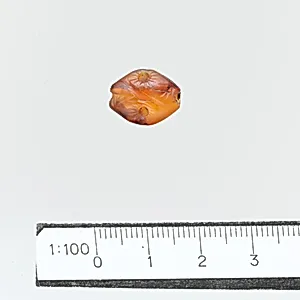
Medium
Carnelian
Dimensions
Other: 7/16 x 9/16 x 1/4 in. (1.1 x 1.4 x 0.6 cm)
Classification
Gems
Culture & Period
Minoan, Crete · Middle Minoan III–Late Minoan I
Department
Greek and Roman Art
Museum
Metropolitan Museum of Art, New York, NY
Credit
Bequest of Richard B. Seager, 1926
Accession Number
26.31.228
Rights
Public Domain
Tags
Art Historical Context
This exquisite amygdaloid seal, from vibrant carnelian around 1650–1500 BCE, hails from Minoan Crete during the Middle Minoan III Late Minoan I periods Shaped like an almond—hence its name—this tiny gem (just 7/16 x 9/16 x 1/4 inches) exemplifies the sophisticated craftsmanship of the Minoan civilization, a Bronze Age culture renowned for its grand palaces at Knossos and Phaistos. Minoan seals like this one were essential tools for administration, used to imprint designs into soft clay or wax to secure documents, goods, or rituals, offering a glimpse into their bustling trade networks and complex society. Crafted from carnelian, a durable reddish-orange semi-precious stone prized for its rich color and hardness, the seal would have been meticulously engraved, likely featuring intricate motifs typical of Minoan glyptic art—such as stylized animals, plants, or hieroglyphic-like symbols in the undeciphered Linear A script. These gems highlight the Minoans' mastery of miniature sculpture and their blend of functionality with artistry, bridging everyday life and symbolic power. Bequeathed to the Metropolitan Museum of Art by archaeologist Richard B. Seager in 1926, this artifact connects us to a vibrant world of seafaring innovators who influenced later Greek culture.