
Seal with Quadruped
Geometric Period (800–600 BCE)
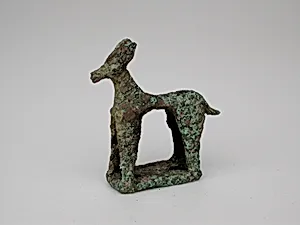
Medium
Bronze
Dimensions
4.1 × 3.8 × 1.3 cm (1 5/8 × 1 1/2 × 1/2 in.)
Classification
votive offering
Department
Arts of Greece, Rome, and Byzantium
Museum
Art Institute of Chicago
Accession Number
196481
Rights
Public Domain
About this artwork
These precious bronzes objects are votives, or devotional gifts, made for gods. They come in many forms. Some are miniature sculptures of animals, mostly depicting horses, deer, and birds. Others are items of personal adornment, including beads and brooches. Quite a few seem once to have been attached to something else. This assemblage is characteristic of the thousands of votives that were hung from sacred trees or placed in sanctuaries around Greece. Once a shrine was full, the votives were ga...
Art Historical Context
### Seal with Quadruped ailing from Ancient Greece's Geometric Period (800–600), this petite bronze seal captures the era's hallmark shift toward stylized figural art. Measuring just 4.1 × 3.8 × 1.3 cm, it features a quadruped—likely a deer or similar animal—rendered in the abstract, geometric forms typical of the time. Greek artists of this period moved away from the Bronze Age's monumental styles, embracing patterns of triangles, meanders, and simple silhouettes to depict animals and humans, reflecting a burgeoning interest in narrative and symbolism on a smaller scale. Crafted in bronze, a durable alloy favored for its workability and prestige, the seal exemplifies early metallurgical skill through lost-wax casting or hammering techniques. As a votive offering from the Arts of Greece, Rome, and Byzantium collection at the Art Institute of Chicago, it was likely dedicated at a sanctuary to honor deities, seek favors, or give thanks. Such objects reveal the everyday piety of ancient Greeks, bridging personal devotion with communal ritual. This unassuming artifact offers a window into a transformative age, when Greece was reawakening culturally after the Dark Ages, laying groundwork for the Classical wonders to come. Imagine holding a piece of that revival in your palm!
About the Artist
Ancient Greek
The artist known simply as "Ancient Greek" represents the anonymous masters of Attic vase painting, a cornerstone of Classical Greek art from the Archaic and Classical periods (circa 700–300 BCE). Little is known of their personal life, as ancient Greek potters and painters rarely signed their works or left biographical traces; early life and training remain not well documented. These creators ope...