
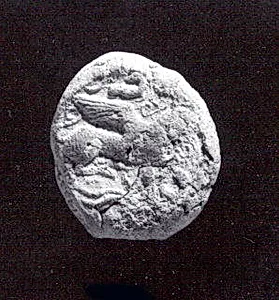
Sealing with stamp seal impression: sphinx
Unknown Artist
ca. 18th century BCE
Medium
Ceramic
Dimensions
Diameter: Seal Face: 2.0 cm Sealing: 2.8 x 2.15 cm Height: 1.8 cm
Classification
Clay-Sealings
Culture & Period
Old Assyrian Trading Colony · Middle Bronze Age–Old Assyrian Trading Colony
Department
Ancient Near Eastern Art
Museum
Metropolitan Museum of Art, New York, NY
Credit
Gift of Mrs. George D. Pratt, in memory of George D. Pratt, 1937
Accession Number
37.143.34
Rights
Public Domain
Tags
Art Historical Context
This ceramic sealing, dating to circa the 18th century BCE, is a fascinating artifact from the Old Assyrian Trading Colony during the Middle Bronze Age. It features an impression made by a stamp seal depicting a sphinx, a mythical creature popular in ancient Near Eastern iconography. As a clay-sealing, it served a practical purpose in ancient administration, likely used to authenticate documents or secure containers in the context of trade. Stamp seals were an important artistic and functional medium in this period, allowing for the reproduction of intricate designs on clay. The small size of this piece—with a seal face of just 2.0 cm in diameter—demonstrates the precision of ancient craftsmanship by unknown artists. Such objects highlight the cultural and economic activities of the Old Assyrian traders. Gifted to the Metropolitan Museum of Art in 1937 by Mrs. George D. Pratt in memory of George D. Pratt, this sealing invites us to appreciate the blend of art and daily life in the ancient world, where even administrative tools carried symbolic imagery like the sphinx.