
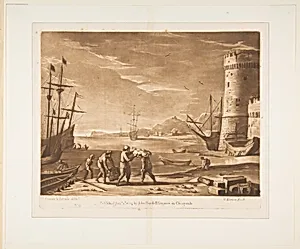
Seaport with Sailors Loading Merchandise
Medium
Mezzotint
Dimensions
sheet: 10 7/8 x 13 11/16 in. (27.6 x 34.8 cm) plate: 8 1/4 x 10 3/16 in. (21 x 25.8 cm)
Classification
Prints
Department
Drawings and Prints
Museum
Metropolitan Museum of Art, New York, NY
Credit
Harris Brisbane Dick Fund, 1917
Accession Number
17.3.3021
Rights
Public Domain
Tags
Art Historical Context
In the bustling "Seaport with Sailors Merchandise," created as a mezzotint in 1774, engraver Richard Earlom faithfully reproduces a composition by the masterful 17th-century French Claude Lorrain (aude Gellée), with publication by John Boydell.orrain, a pioneer of idealized landscape painting, evokes the golden light and serene harmony of classical antiquity, blending towering architectural silhouettes, laden ships, and diligent sailors with boats dotting a shimmering harbor. This scene captures the poetic essence of 17th-century seaports, symbolizing commerce and exploration in an era of expanding European trade. Mezzotint, a revolutionary printmaking technique perfected in the 18th century, allowed Earlom to mimic the subtle tonal gradations and atmospheric glow of Lorrain's oil paintings—effects nearly impossible with earlier etching methods. By roughening a copper plate and selectively polishing it, mezzotints produced velvety blacks and luminous highlights, making fine art accessible beyond elite collectors. Published by Boydell, a key figure in London's print trade, this work exemplifies the 18th-century boom in reproductive prints that democratized masterpieces. Housed in the Metropolitan Museum of Art's Drawings and Prints department (Harris Brisbane Dick Fund, 1917), this 10⅞ × 13⅝-inch sheet invites visitors to ponder Lorrain's enduring influence on later landscapists, from Turner to the Romantics, while highlighting printmaking's role in preserving and sharing artistic heritage.
About the Artist
Claude Lorrain (Claude Gellée)|Richard Earlom|John Boydell · 1604–1682
Claude Gellée was born around 1600 in the village of Chamagne in the Duchy of Lorraine, from which he would take the professional name by which history knows him: Claude Lorrain. Orphaned young, he traveled south to Rome as a teenager, eventually finding his way into the Naples workshop of Goffredo Wals before apprenticing with the Roman landscapist and fresco painter Agostino Tassi around 1622. F...