
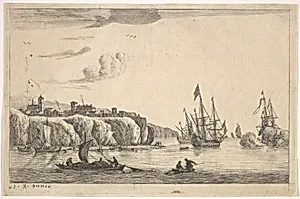
Seaport with Village on a Cliff
17th century
Medium
Etching
Dimensions
sheet: 5 3/8 x 8 3/16 in. (13.7 x 20.8 cm)
Classification
Prints
Department
Drawings and Prints
Museum
Metropolitan Museum of Art, New York, NY
Credit
Bequest of Grace M. Pugh, 1985
Accession Number
1986.1180.1414
Rights
Public Domain
Tags
Art Historical Context
Reinier Nooms, known as Zeeman (“sailor”), was a Dutch printmaker celebrated for his maritime subjects during the seventeenth-century Golden Age, when the Netherlands dominated global trade and naval power. Created as an etching, *Seaport with Village on a Cliff* captures this era’s fascination with the sea. The composition shows sturdy merchant vessels anchored below a steep cliffside village, with small figures animating the shore and decks. Such scenes celebrated both the romance of seafaring and the economic vitality of Dutch ports. Etching allowed Nooms to render intricate details—rigging, waves, and architectural textures—with remarkable precision while producing affordable prints that reached wide audiences. The medium’s fine line work suited his firsthand knowledge of ships, gained from voyages that earned him his nickname. Today the print in the Metropolitan Museum’s collection preserves a vivid record of seventeenth-century coastal life, reminding viewers how Dutch artists turned everyday maritime activity into enduring symbols of exploration and prosperity.
About the Artist
Reinier Nooms, called Zeeman · 1623–1664
Reinier Nooms, known as Zeeman ("sailor" in Dutch), was a prominent Dutch maritime painter, draftsman, and etcher of the Golden Age, born around 1623 or 1624 in Amsterdam and dying there in 1664 at about age 40. Before turning to art around 1643, he led a rough life as a professional seaman, which informed his unparalleled accuracy in depicting ships, ports, naval battles, and coastal scenes—knowl...