
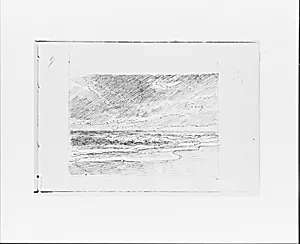
Seascape (from Sketchbook VII)
Medium
Black ink, graphite, on off-white wove paper
Dimensions
5 x 7 1/2 in. (12.7 x 19.1 cm)
Classification
Drawing
Culture
American
Department
The American Wing
Museum
Metropolitan Museum of Art, New York, NY
Credit
Purchase, Gifts in memory of Stephen D. Rubin, 1992
Accession Number
1992.2.1ff
Rights
Public Domain
Tags
Art Historical Context
William Trost Richards' *Seascape (from Sketchbook VII)*, created in 1886, visitors into the intimate world of a master's preliminary studies. Rendered in black ink and graphite on modest sheet of off-white wove (5 x 7½ in.), this small-scale work captures the essence of the sea with remarkable precision. Housed in The Metropolitan Museum of Art's American Wing, it reflects American artistic traditions of the late 19th and entered the collection through a 1992 purchase honoring Stephen D. Rubin. Richards (1833–1905), a leading figure in American landscape painting, was celebrated for his Hudson River School affiliations and later luminist style, emphasizing light, atmosphere, and naturalistic detail. His seascapes, often drawn from direct observation along the Northeast coast, showcase a Pre-Raphaelite-influenced fidelity to nature. Sketchbooks like this one reveal his methodical process—quick yet exacting lines in ink and graphite that build form, texture, and movement in waves and horizons. This piece highlights the significance of preparatory drawings in 19th-century American art, bridging studio paintings and on-site inspiration. For enthusiasts, it underscores Richards' lifelong passion for the ocean's rhythms, offering a window into how grand visions began with humble sketches.
About the Artist
William Trost Richards · 1833–1905
William Trost Richards (1833–1905) was a prominent American landscape and marine painter born in Philadelphia, where he attended Central High School before beginning his artistic training. Between 1850 and 1855, he studied part-time under the German-born Hudson River School artist Paul Weber while working as a designer and illustrator of ornamental metalwork. He exhibited his first works at the Pe...