
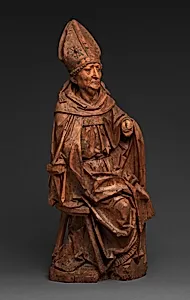
Seated Bishop
ca. 1495
Medium
Limewood and gray-black stain
Dimensions
35 1/2 x 14 x 5 7/8 in. (90.2 x 35.6 x 14.9 cm)
Classification
Sculpture-Wood
Culture
German
Department
The Cloisters
Museum
Metropolitan Museum of Art, New York, NY
Credit
The Cloisters Collection, 1970
Accession Number
1970.137.1
Rights
Public Domain
Tags
Art Historical Context
Step into the serene world of late 15th-century German sculpture with *Seated Bishop*, crafted around 1495 by Tilman Riemenschneider, one of the era's master wood carvers This life-sized limewood figure, standing at 35 inches tall, captures a bishop in contemplative repose, his carved robes flowing with intricate folds that showcase Riemenschneider's exceptional skill. Housed in The Cloisters at the Metropolitan Museum of Art, it exemplifies the Northern Gothic tradition, where sculptors like Riemenschneider elevated wood into a medium rivaling stone. Limewood, soft yet durable, allowed for the delicate undercutting and expressive details that define Riemenschneider's style—think Würzburg altarpieces alive with emotion. Here, a subtle gray-black stain enhances the wood's natural grain, lending a weathered, almost reliquary-like patina that evokes the sacred aura of ecclesiastical figures. Created during the transition to the Renaissance, this piece reflects the enduring power of Late Gothic realism in devotional art. Bishops, as symbols of spiritual authority, were common in church decorations, and this serene portrayal invites reflection on faith and hierarchy in medieval Germany. Acquired for The Cloisters Collection in 1970, it remains a testament to Riemenschneider's legacy, blending technical virtuosity with profound cultural resonance.