
Seated Bodhisattva
8th century
Medium
Wood core, dry lacquer, traces of gold leaf
Dimensions
61 × 43.2 × 32.3 cm (24 × 17 × 12 3/4 in.)
Classification
wood
Department
Arts of Asia
Museum
Art Institute of Chicago
Accession Number
111380
Rights
Public Domain
About this artwork
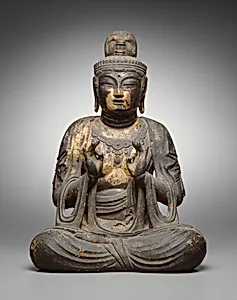
This rare and important sculpture represents a Buddhist bodhisattva, or bosatsu, an enlightened and compassionate being who postponed Buddhahood in order to help save others. Calm, stately, and full-bodied, the bosatsu is seated in a frontal, meditative pose; his gracefully held hands, raised midair, make a gesture of assurance. Buddhism, which originated in India with the teachings of the Buddha Sakyamuni, or Siddhartha Gautama (c. 563-c. 483 B.C.), was named the official religion of Japan at t...
Art Historical Context
Behold the *Seated Bodhisattva a serene 8th-century masterpiece from the Art Institute of's Arts of Asia collection. Carved with a wood core and clad in dry lacquer—a sophisticated technique where layers of lacquer are applied over a removable mold—this sculpture stands at 61 × 43.2 × 32.3 cm. Faint traces of gold leaf at its original opulent sheen, evoking the divine glow of enlightenment. Crafted during Japan's Nara period (710–794), when Buddhism flourished under imperial patronage, this work exemplifies the era's devotional art. Dry lacquer (known as *kanshitsu* in Japanese) allowed artisans to achieve remarkable lightness, durability, and intricate detailing, from flowing robes to a meditative posture symbolizing compassion and wisdom. Bodhisattvas, enlightened beings who vow to aid all sentient creatures, were central to Mahayana Buddhism, adorning temples like Todai-ji. This anonymous sculptor's skill captures spiritual tranquility, inviting contemplation. Its survival through centuries underscores the enduring cultural reverence for Buddhist icons in East Asia, bridging ancient devotion with modern admiration.
About the Artist
Unknown
The artist designated as "Unknown" in our virtual museum's collection exemplifies a poignant chapter in art history: creators whose identities have faded into obscurity despite the enduring power of their work. With only one known artwork attributed to them in our holdings, this figure represents countless anonymous hands that shaped visual culture across centuries. Museums worldwide, including th...