
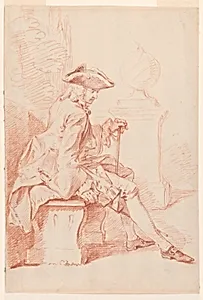
Seated Gentleman
Classification
figures
Department
Smithsonian Collection
Museum
Smithsonian American Art Museum
Credit
Bequest of Erskine Hewitt
Accession Number
1938-57-212
Rights
Public Domain
About this artwork
Research in Progress
Art Historical Context
**Seated Gentleman** by Hubert-François Gravelot (French, 1699–1773) captures an elegant figure from the early 18th century, dated around 1735. Gravelot, a master engraver and designer, bridged French rococo finesse with English tastes after arriving in London in 1732. This work, classified as a study of figures, likely served as a preparatory sketch for illustrations or decorative prints, reflecting the period's fascination with poised, aristocratic portraiture. Active in England during the 1730s and 1740s, Gravelot influenced British artists like William Hogarth through his light, graceful line work and ornamental style. Though the medium remains unidentified amid ongoing research, such pieces were typically ink drawings or watercolors, essential for bookplates, fashion plates, and theater designs that defined rococo elegance. Bequeathed to the Smithsonian American Art Museum by Erskine Hewitt, it exemplifies transatlantic artistic exchange. This intimate depiction invites us to ponder the gentleman's world—perhaps a patron or imaginary ideal—frozen in a moment of refined leisure, highlighting Gravelot's skill in evoking personality through subtle pose and attire. A gem of 18th-century draftsmanship, it underscores the era's cultural fusion.