
Seated Giant
by 1818 (possibly 1814–18)
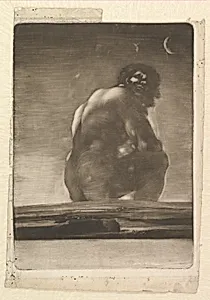
Medium
Burnished aquatint, scaper, roulette, lavis (along the top of the landscape and within the landscape)
Dimensions
Plate: 11 3/16 × 8 3/16 in. (28.4 × 20.8 cm) Framed: 21 3/4 × 19 in. (55.2 × 48.3 cm)
Classification
Prints
Department
Drawings and Prints
Museum
Metropolitan Museum of Art, New York, NY
Credit
Harris Brisbane Dick Fund, 1935
Accession Number
35.42
Rights
Public Domain
Tags
Art Historical Context
Francisco de Goya y Lucientes, the visionary Spanish artist of the late 18th and early th centuries, created *Seated Giant* around 1814–18, during a turbulent period marked by the Napoleonic Wars and his own deepening disillusionment. This haunting print belongs to Goya's late experimental phase, echoing the surreal intensity of series like *Los Disparates* (or *Proverbios*), where he explored the grotesque and the fantastical. As a male nude towering in a mysterious landscape, the giant embodies Goya's fascination with human vulnerability and mythic scale, blending Romantic individualism with proto-Surrealist dream logic. Goya's mastery shines in the innovative printmaking techniques: burnished aquatint for velvety tonal depths, scraper for sharp highlights, roulette for textured surfaces, and lavis washes evoking atmospheric skies and earthy grounds. These methods, pioneered by Goya, pushed aquatint beyond mere reproduction into painterly expression, making prints like this intimate plate (11 3/16 × 8 3/16 in.) rival oil paintings in drama. Housed in the Metropolitan Museum of Art's Drawings and Prints department (acquired via the Harris Brisbane Dick Fund in 1935), *Seated Giant* invites visitors to ponder Goya's inner world—deafened, aged, and defiant—where colossal figures confront isolation amid vast, shadowy realms. A testament to his enduring influence on modern art.
About the Artist
Goya (Francisco de Goya y Lucientes) · 1746–1828
Francisco José de Goya y Lucientes (1746-1828) was a Spanish painter and printmaker considered the last of the Old Masters and the first of the moderns. Rising from modest provincial origins to become First Court Painter to Charles IV, Goya's career spanned the Enlightenment's optimism and the brutal Napoleonic invasion that shattered it. A mysterious illness in 1793 left him permanently deaf and ...