
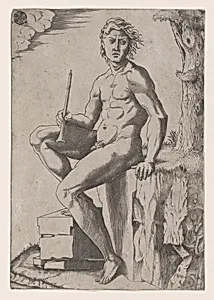
Seated Man Holding a Flute
ca. 1500–50
Medium
Engraving
Dimensions
6 7/8 x 4 3/4 in. (17.4 x 12.0 cm)
Classification
Prints
Department
Drawings and Prints
Museum
Metropolitan Museum of Art, New York, NY
Credit
Gift of Felix M. Warburg and his family, 1941
Accession Number
41.1.206
Rights
Public Domain
Tags
Art Historical Context
In the early 16th century, the Italian Renaissance, *Seated Man Holding aute* emerged as a masterful collaboration between engraver Marcantonio Raim and sculptor Baccio Band (ca. 1500–50). Raimondi, one of the era's premier printmakers, translated Bandinelli's design into an exquisite engraving on a modest sheet measuring 6 7/8 x 4 3/4 inches. Housed in the Metropolitan Museum of Art's Drawings and Prints department, work exemplifies how prints revolutionized art dissemination, allowing designs to reach collectors far beyond Italy. The image depicts a serene male nude seated amid trees, flute in hand—a nod to classical antiquity's ideal of harmonious beauty and leisure. Engraving's intricate technique, involving incised metal plates inked and pressed onto paper, captures fine details like muscular anatomy and foliage texture, showcasing Raimondi's precision. Bandinelli's influence adds a robust, sculptural quality, bridging drawing, sculpture, and music in Renaissance humanism. This intimate print, gifted by Felix M. Warburg and family in 1941, invites reflection on the period's fascination with the male form and pastoral themes, making high art accessible to all visitors today.
About the Artist
Marcantonio Raimondi|Baccio Bandinelli · 1475–1534
Marcantonio Raimondi (c. 1480–1534), born near Bologna, Italy, emerged as one of the Renaissance's premier engravers, revolutionizing printmaking through his mastery of reproductive techniques. He trained in the workshop of the goldsmith, painter, and niellist Francesco Francia, whose influence is evident in his early engravings, such as the goldsmith-like shading in *Pyramus and Thisbe* (1505), h...