
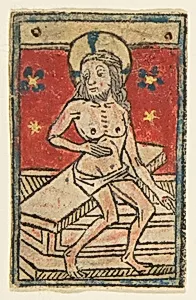
Seated Man of Sorrows (Schr. 910)
15th century
Medium
Woodcut, hand-colored
Dimensions
sheet: 2 1/16 x 1 5/16 in. (5.2 x 3.3 cm)
Classification
Prints
Department
Drawings and Prints
Museum
Metropolitan Museum of Art, New York, NY
Credit
The Elisha Whittelsey Collection, The Elisha Whittelsey Fund, 1966
Accession Number
66.529.10
Rights
Public Domain
Tags
Art Historical Context
This delicate 15th-century woodcut, *Seated Man of Sor (Schr. 910)*, created by an anonymous German artist, captures a poignant image of Christ seated in suffering, a popular devotional motif known as the "Man of Sorrows." Measuring just over 2 by 1 inches, its tiny scale made it ideal for personal prayer books or altarpieces, inviting intimate contemplation of Christ's passion and sacrifice. Housed in the Metropolitan Museum of Art's Drawings and Prints department, reflects the Northern European artistic tradition of the late Gothic period transitioning into the Renaissance. Woodcuts like this one revolutionized art accessibility in 15th-century Germany, enabling affordable production of religious prints through carved wooden blocks inked and pressed onto paper. The hand-applied coloring—likely watercolor or tempera—adds vivid life to the somber scene, heightening emotional resonance for lay viewers illiterate in Latin scripture. Such images proliferated amid growing lay piety, fueled by movements like the Devotio Moderna, emphasizing personal devotion over elaborate church rituals. As a testament to early printmaking's cultural power, this anonymous work underscores how miniature masterpieces democratized sacred art, fostering empathy with Christ's humanity in everyday medieval life.